Showing posts with label fiction. Show all posts

01 December 2016

Last Month in Review: November 2016

It’s been a LONG time since I’ve written a post like this -- a frame of time that could as easily be measured in years as months -- so I’m happy to be back in the saddle for some bookish blogposts. In chronological order, here is what I’ve read:

1. The Man Who Shot Out My Eye Is Dead by Chanelle Benz.  This book winz for great title and author name. This collection of short stories is very strong, and while the narrative voice varies from story to story, you can feel the unifying sensibility behind each one. Debut book. This author studied with George Saunders, and given that, the darkness in most of these stories is unsurprising.


2. Desperation Road by Michael Ferris Smith. Eh.  I was underwhelmed by this one.  I liked the story but felt I had read it in various permutations many times before. Man is released from prison, goes home, gets beaten up by the family who believes he deserves no mercy after what he’s done.  He crosses paths with a woman who turns out to have a unique connection to his past.


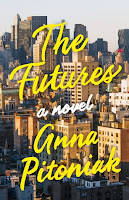
3. The Futures by Anna Pitoniak. First novel about a young couple trying to make it in Manhattan after graduating from Yale.  Another meh read for me.  The writing was good, but reading about how hard it is to be a young, white, Yale grad from a privileged background doesn’t exactly draw out my sympathy.


4. Sweetbitter by Stephanie Danler. This book surprised me with how much I liked it.  I brought it with me on vacation for an easy beach read, and it was certainly that, but I LOVED reading all of the food and wine descriptions, as well as getting the inside scoop of what it’s like to be an underserver in an incredibly popular and well-respected NYC restaurant.


5. The Little Paris Bookshop by Nina George. Ugh. I picked this book up to read the day after the election because I wanted something that was sweet and charming and life affirming, all of which are adjectives that readers have applied to this book.  I thought it was pretty 2-dimensional and occasionally insipid. Very disappointed, since the premise of it is so good: a barge bookstore owner on the Seine doesn’t sell the book that the customer wants, he sells the book that the customer needs.


6. This Is the Story of a Happy Marriage by Ann Patchett (audio). I had lunch with Ann Patchett at the end of September and spending that time with her made me want to go back and listen to her essay collection.  Despite being a bonafide novel reader through and through, this is probably my favorite work of hers. I love the honesty and clarity behind each piece.


7. American War by Oman El Akkad. Holy shit, this was a good book.  Set about 50-60 years in the future, this novel tells the story of Sarat Chestnut and her life before, during, and after the Second Civil War in America. Refugee camps, suicide bombers, the secession of the Magnolia States, plotting, politics, and intrigue.  This book was well written, brilliantly paced, and rather frightening. Put it on your radar now, as it will be published in April 2017. 

01 June 2016

Last Month in Review: May 2016

Photo credit
My reading concentration is slowly improving, so I’m a-gonna talk about the books I read last month as a  prelude to writing an actual book review.  Some of these books were amazing.  In chronological order, here’s what I read:

Mischling by Affinity Konar. Holy shit, y’all.  This is some serious stuff. Here’s the succinct blurb that I gave the publisher, else I’d just be rambling up in here tonight: It’s difficult to imagine a more horrific subject for a novel than the sadistic experiments Dr.Mengele performed on twins in Auschwitz, but debut author Konar manages to craft something magnificent from such dark origins. Pearl and Stasha tell their stories in alternating chapters, each twin doing her utmost to protect her sister in the camp, their shared history almost enough to create their belief in a shared future on the other side. Konar’s language is so fresh and inventive, even occasionally playful, that it creates a powerful and shocking juxtaposition against the narrative. This author is going places, and after reading this book, I will want to be along for the ride. Every. Single. Time. 

The Summer Before the War by Helen Simonson.  This was charming.  Did you read and love her previous book, Major Pettigrew’s Last Stand? If so, you would probably like this.  Did you love the first two seasons of Downton Abbey, right before and then during The Great War? Then you’d probably like.  It’s a small English village, a woman who has been scandalously hired to teach Latin to school boys, and all of the insulated gender and class restrictions of that age. This is not one of those life-changing-but-exhausting-to-read books. This is a book you’ll want to read when you want to escape a little without putting your mind entirely on vacation.

Redemption Road by John Hart.  This was an audio book I listened to, narrated by Scott Shepherd.  Pretty good.  I don’t read thrillers, by and large, but the publisher sent an advance listening copy to the store, so I nabbed it. Maybe it’s because I’m required to listen at a slower pace than I would read if I had a physical book in front of me, but there were several plot "twists" in this book that I saw coming from pretty early on. There were a few moments where listening to this book creeped me out, but I doubt anybody who regularly reads thrillers would feel that way.  I felt the ending was a bit too pat, and to me the serial killer identity was pretty obvious from the early chapters, but the writing is really solid and Hart brilliantly evokes certain parts of North Carolina with his prose.

Between the World and Me by Ta-Nehisi Coates.  This was an audio book that I purchased for the specific purpose of driving home from Portland, ME one weekend.  It was the perfect length.  I figured that I would like this book and find it both moving and anger-inducing, and I was spot-on about that.  But what I wasn’t expecting about this book was the sheer lyricism of the prose.  Really beautifully written. The author reads it himself. I highly recommend this one.

Commonwealth by Ann Patchett.  This is a quiet novel, especially compared to Bel Canto or State of Wonder.  It opens on a fateful day in LA -- a community comes together for a christening, but their lives are forever changed when the husband of one family falls in love with the wife of another. We see the parents and the children across the years and the consequences and emotional fallout wrought by that first infidelity.  Very good.  Patchett often sneaks up on the reader with her writing and insights.


The Best Revenge and The Best Revenge: Time of the Basilisk by Arsinoe de Blassenville.  This is a pairing of Harry Potter fan fictions, the first of which is novel length and the second of which is a novella. They begin with the “What if Snape was the first wizard Harry interacted with?” trope and they end with events from the canon book two, but in reality, all of the action takes place within Harry’s first year.  Because of his relationship with Lily Evans Potter, Snape becomes Harry’s wizarding proxy and things turn out very, very differently. I love these stories -- they’re well written and well paced, and they show sides of both Hufflepuff and Slytherin that Rowling herself was unable to show due to the Harry filter.

Not a terrible showing. I don’t know how many pages the fanfics would be, but Goodreads tells me that my page count for all of the other items comes to 1,753 pages. Except where noted, all of the books I read were advance reading copies provided by the publisher, often at my request.

How ‘bout y’all?  What books were you most excited about reading in May?  

16 January 2015

Book Review: The Darkest Part of the Forest by Holly Black


Let me say this first: Holly Black's new novel, The Darkest Part of the Forest, is the first YA fantasy that I've read in a few years that I loved.  (Quite possibly since she published The Coldest Girl in Coldtown, which I liked a lot, but didn't love quite as much as I love this book.)

Hazel Evans and her brother Ben have grown up in Fairfold, a town that is to the faerie world what Sunnydale, California, is to the vampire world. People occasionally disappear, and if they happen to be outsiders, well, then there doesn't need to be too much fuss.  The people of Fairfold know the rules and raise their children to know them, too. They've reach an uneasy détente with the Fair Folk.

In the woods just outside of town, there's a glass coffin with a boy inside -- a heartbreakingly beautiful boy with horns, locked in an enchanted sleep. It just so happens that Hazel and Ben are both in love with the boy, pouring out their secrets and desires to him as the years go by.  The others kids in Fairfold like to party 'round (and on top of) the coffin, but occasionally one of them goes too far, with unfortunate consequences.  The glass itself is unbreakable, or so they all think, since the glass coffin endures through generations of drunk kids doing their best to shatter it.

Then one day, the glass coffin lies in shards, the boy inside gone missing. That same morning, Hazel wakes up with bits of the forest covering her and her bedclothes, and she doesn't know how they got there.  Oh, and maaaaaybe there's a sword. And maaaaaybe she's been losing time and blacking out about certain things.  And did I mention that in her youth, Hazel made a rash bargain with the Faerie King and that for days she's been receiving mysteriously ominous messages regarding her promise?

In the mean time, strange things are beginning to happen in Fairfold.  The balance between the townspeople and the faerie world tips and the people need a scapegoat.  Perhaps they've found it in Jack, who is Ben's best friend and who also happens to be changeling.  Sorry, should have mentioned that bit earlier!

Here are some other bits that might be important to know: Ben has a magically-bestowed gift of music! And as a child, Hazel plays at being a brave knight while her brother sings, and together they drive off the dark spirits of the forest! But then Hazel kisses the boy her brother loves, or rather, maybe that boy kisses her (aside: Hazel kisses a lot of boys.  It's kind of her thing.). But from that day onward, Hazel and Ben's relationship changes.

Really, there is so much going on here.  Holly Black plays with standard tropes, standing many on their heads and letting a few run the expected course, which constantly kept me guessing.  Which ones would she keep intact? Which ones would turn off at a 90 degree angle? And which ones would she invert altogether? Holly's writing is good and solid, never taking the reader out of the story, and she hits just the right blend of plot, character and pacing, overlaying it all with a cloak whose warp is humor and whose woof is darkness, so you can never really separate one from the other.  It's a coming of age tale, it's love and romance, it's a high quest adventure, and at the end of the day, it's also a story of loyalty and family.  It's brilliant.

My bookstore was lucky enough to host the book launch for Holly earlier this week.  Some fellow booksellers from Brookline Booksmith made the trek to our store for the launch, and we went all-out for it, dressing up in costume, serving faerie wine (drink it if you dare!), and even creating our own glass coffin so that attendees could use it for selfie photo ops. We had a grand and glorious time!  Standing room only, and a room full of fans, friends, and other great authors.

Holly, signing stock in the back.  This is
where the magic happens!
Showing a fellow bookseller how to
create my custom spiral display
Beware the faerie wine, ladies!
Here I am in the glass coffin
My amazing coworker, Hannah, who planned the
event and co-created the coffin
Holly trapped in a device of her own making
(photo courtesy of Hannah Moushabeck)
You can see authors Sarah Rees Brennan
and Cassandra Clare in the audience here. Not
pictured, but in also attendance, were Kelly Link,
Gavin Grant, and Deborah Noyes
How many booksellers can you fit into
 a glass coffin with Holly Black?
NB: Little, Brown published this book in the US on Tuesday, 13 January, and I read an advance reading copy provided by the publisher at my request several months ago. This book qualifies for my "diversify your life" label because there is one main character who is gay and a secondary character who is bi-sexual, at least by human standards.  My guess is that the fair folk don't gauge sexuality the same way we do.

05 November 2014

National Book Award Fiction Finalists: My Thoughts


While I'm an avid reader and a reasonably good bookseller, I've never claimed to have my finger on the pulse of the book award circuit.  So I was as surprised as anybody when I discovered that for the first time since I've started paying attention to these things, I have read, or at least read in, all five of the finalists for the fiction award.

Of them, I only have completed two: Emily St John Mandel's excellent break-out novel, Station Eleven and the Marilynne Robinson's literary masterpiece, Lila. But just because I didn't finish reading the other three doesn't mean that I didn't like them.  On the contrary, I very much liked what I read of them.  One of the things about being a bookseller that might seem strange to a civilian, is that in addition to reading the things I like, I also have an obligation to read widely, beyond my personal preferences, so that I can better serve my customers.

I also am one of the four readers for my bookstore's signed First Editions Club, where we select one work of literary fiction each month and send signed copies to our club members. For this part of my job, I have to read the first 50-75 pages of an additional 6-8 books each month (on average), all on my own time outside of work.  For obvious reasons, I cannot finish them all, so even when I like a book, if I have a coworker who has finished it, I'm less inclined to spend more of my time to complete it. Why? Because now I have a secondary repository of book knowledge to rely on: I can recommend a book to a customer when I know that Nancy (or Hannah or whomever) has loved it and why she has loved it.

(On a slightly braggadocian note, of the five NBA books on the short lit, our First Editions Club committee picked three of them.  And if we'd had our way with getting signed copies of another one, there would have been a fourth, but the author either wasn't touring or wasn't in the US when we wanted to pick the book. Go, us!)

So, with all of that being said, here are my thoughts on the National Book Award finalists for fiction in 2014:

An Unnecessary Woman by Rabih Alameddine is wonderful, telling a very quiet story of older woman living in Beirut who has translated one book per year from the world literary canon into Arabic.  I read about half of this book and very reluctantly put it down. Not only does the author paint a vivid portrait of the cultural importance of Beirut, along with its devastations during the wars, but we get the importance of translation itself, along with its intricate give and take.

I read the first 100 pages or so of Anthony Doerr's All the Light We Cannot See, which is set during World War II. I've noticed tons of reviews of this book popping up since it was published in April of this year, and two of my coworkers read it and loved it, so I felt less guilty putting this one down than I otherwise would have.

Short story collections don't often go head to head with novels for the major literary awards, but Phil Klay's debut collection, Redeployment, is handily able to take on the powerhouses.  As the title suggests, these are soldiers' stories, particularly in Iraq and Afghanistan.  I read the first two of them and they were extremely well done, and though ultimately this was not the book for me, I'm happy I bought a signed, first edition of it when I visited Nashville earlier this year.

I've been reading Emily St John Mandel's books since she first published Last Night in Montreal in 2009. I'm thrilled for her that her hopeful post-apocalyptic novel, Station Eleven, is getting the critical acclaim that indie booksellers have been giving her for years.  I think this book ties with the Anthony Doerr for having the most widespread appeal to general readers. I would put either book into the hands of almost any fiction reader.

Lila by Marilynne Robinson concludes her trilogy set in the small town Gilead, Iowa, of yesteryear.  Like the Alameddine, it's a quiet story, largely the imagined inner life of the title character. I also happen to think that Lila ties with An Unnecessary Woman for being the most literary of the finalists, and thus if I had to make a prediction for the winner, it would be one of these two.

NB: Edited to add this -- It doesn't hurt that Marilynne Robinson is basically the winningest American novelist, ever.  For her last four books published (3 novels, one nonfiction), she has won six major literary awards: PEN/Hemingway, the Pulitzer (2x), the National Book Award, the National Book Critics Circle Award, and the Orange Prize. That's not counting the lesser-known awards, or the major awards she was a finalist for but for which she didn't win.  Dayum.

07 July 2014

Caitlin Moran Readalong: Introductory Post

Hi, y'all, and welcome to the pre-publication readalong for Caitlin Moran's novel, How to Build a Girl! I'd like to extend a thank you to Harper Collins for sponsoring our fun; if you're following along and think you'd like to read the book, you can pre-order it here. 

This week we're introducing ourselves before diving into the discussion.  My name is Emily and I'm an independent bookseller by trade, and my blog, which is in its sixth year (egads--I had to look that up just now), is split more or less evenly between books and travel. Hence, my alter-ego Crowe both Flies and Reads. 

Now here's a little confession -- I've never read Caitlin Moran before. In fact, I only recently learned how to pronounce her name: Cat-lin.  But as an independent bookseller, I've sold lots of her books, and as a blogger and a feminist, I've read lots of rave reviews of her earlier books. Many of those reviews are from bloggers participating in this readalong, including What Red Read, Devouring Texts, Reading the Bricks, Reading Rambo, Nylon Admiral, and others.  Mostly I just want to read her because she gets that sexism is one of the hidden "-isms" of this world and I think she's funny and smart and wants all women (and men, too) to realize that feminism is neither a bad word nor an outmoded worldview.

Caitlin Moran herself might be checking in every now and then as we're discussing How to Build a Girl, and she sent me an email conveying her enthusiasm for what we're doing: 
 "...I just want to kiss you from here, because my three hobbies are long country walks, sexual activity and THE REVOLUTION, and every time another woman gets it - when they nod and go "I know what you're trying to do, dude. I'm with you" - it thrills my mascara-stained heart to bits and back.

So yes - thank you: endlessly, properly, and in an oddly un-British way. I hope you like the new book, How To Build A Girl - I wrote it with all the love I could, and I cried like a psychopath writing loads of it. "I'm moving me!" I wept. "I am mining my guts! I must stop talking to me in the third person!" And if you don't like it, let's just pretend it never happened, and move onto the next one. That's even better. It's called How To Be Famous..."
I can't wait to delve into our discussion.  So without further ado, here is the readalong schedule.  This is a comparatively short book, so we should be able to get a lot of mileage out of each section and it shouldn't be too difficult to complete each week's reading.  I'm trying to get something straightened out with the Linky folks, so until the linky appears, please leave a link to your post in the comments instead.  

July 7: intro
July 14: pp. 1-58 (part one)
July 21:pp. 61-128 ( chapters 5-10)
July 28: pp. 128-190(chapters 11-15)
Aug 4: 190-246 (chapters 16-20)
Aug 11: section #3 sends wrap-up

08 April 2014

Book Review: The President's Hat by Antoine Laurain


A fellow bookseller just created a new section in our bookstore called Read the World, featuring fiction, poetry, and essays translated into English.  He's a big proponent of translation and is in fact helping to put together a symposium on the importance and the future of translation.  Sadly, browsing the new section in my bookstore made me realize that I don't read many books that were not originally written in English.  Now, a large part of this is not so much my fault as it is the nature of the American publishing industry.  According to a 2007 study done by the University of Rochester, a scant 3% of the books published in the US are in translation. A quick survey of my Goodreads stats shows that I've read three books in translation over the last twelve months, and now that I'm aware of the situation, I'm going to see what happens when I actively seek out works in translation to read this year.  Thank goodness for Europa Editions and other small publishers who make world literature available to those who read only English!

One that I have recently read is called The President's Hat by Antoine Laurain, which I picked up not because it was originally written in French, but because it sounded fun and had actually been selling fairly well in the store.  Lucky for me, it turned out to a delightful little novel. It's set in France in the 1980s when Francois Mitterand was the president of France, and it is basically the story of what happens when you believe than an object can empower you to take control of your own life.

It opens with an accountant named Daniel, who decides to treat himself to a solo dinner at a fancy brasserie one night when his family is out of town.  Not long after he's ordered, President Francois Mitterand sits down with a small party at the table next to him. The President accidentally leaves his hat behind on the banquette between himself and Daniel, so Daniel surreptitiously picks it up and leaves with it, thinking of it as an accidental souvenir of the night he sat next to the President.  But lo and behold, after he starts wearing the hat, Daniel begins acting a bit differently at home and at work.  He takes charge during a business meeting, he gets a promotion, he acts more confidently and with authority--that sort of thing.  He's just beginning to attribute his new success to the President's hat when he accidentally leaves it behind on the train...

...Enter a young woman named Fanny, who notices an abandoned hat on the luggage rack of her train. It's clearly going to be next to impossible to find the owner, so she dons that hat herself, little knowing what is in store for her.  Now she is feeling empowered and emboldened in new ways.  Fanny finds a way to break off an unproductive affair with her married love, and then the short story she submits to a national contest wins the grand prize. Now she in turn leaves the hat on a park bench, where it gets picked up by Pierre, a once-mighty perfumeur who has fallen on hard times...

...You can guess what happens when the perfumeur puts on the President's hat, n'est-ce pas?

We see various people whose lives are changed by this presidential hat, and the big question is, does the power lie within the hat, or does it simply awaken the power in each individual who wears it?  I ended up thinking of Mitterand's hat as a cross between a benevolent version of Tolkien's One Ring and Mary Poppins, transferring its attachment from one owner to the next, always going where it happens to be needed.

For a small novel (it barely reaches 200 pages), it really covers a lot of territory both large (love, life, work, politics) and small (random chances can change your life, and so can accessorizing). Though I read it in two short sittings, the quiet contentment that pervades these pages stayed with me for days--a kind of magic all its own.  I recommend it to just about any reader, but especially if you're looking for a book that is life-affirming without being hokey, or gentle without being dull. The President's Hat got lot of raves in France and it won both the Prix Landerneau Decouvertes and the Prix Relay des Voyageurs in 2012.  Sadly, the translation is not attributed to any one person but to Gallic Books in general.

What about y'all?  Do you seek out works in translation to read? Have you read anything marvelous lately that was not in its original language?

NB: I read an uncorrected proof version of this book that I found in the ARC pile at my bookstore.  It is  published in the US by Gallic Books, which is distributed by Consortium.

26 March 2014

Reprise: Where'd You Go, Bernadette? by Maria Semple


I'm off to Nashville, y'all. Home of the imitation Parthenon, country music and my husband's extended family, among other things. I'm trying really hard to post twice a week to the blog, so what follows is my original review of Maria Semple's Where'd You Go, Bernadette, which I first read book back in August 2012.  I'm updating this review to include some information about the audio book, which I have recently listened to.  When I first read Bernadette, which I really liked, I claimed that it was the right book for me at the right time. Now, however, I might go so far as to say that it was simply the right book, full stop.  A book that I liked a couple of years ago has now become one of my favorite audio book experiences.  I absolutely loved it and I had several moments where I lingered in my car long after reaching my destination, just to stay immersed in the story.

Summary (from Goodreads): Bernadette Fox is notorious. To her Microsoft-guru husband, she's a fearlessly opinionated partner; to fellow private-school mothers in Seattle, she's a disgrace; to design mavens, she's a revolutionary architect, and to 15-year-old Bee, she is a best friend and, simply, Mom. 
Then Bernadette disappears. It began when Bee aced her report card and claimed her promised reward: a family trip to Antarctica. But Bernadette's intensifying allergy to Seattle--and people in general--has made her so agoraphobic that a virtual assistant in India now runs her most basic errands. A trip to the end of the earth is problematic. To find her mother, Bee compiles email messages, official documents, secret correspondence--creating a compulsively readable and touching novel about misplaced genius and a mother and daughter's role in an absurd world.

Oddly enough, I don't think this summary does much for the book, but two of the blurbs on it really work for me. Garth Stein says that it is "a compassionate look at family dysfunction, the paralysis of genius, and good old-fashioned parental love" and Jonathan Franzen "tore through this book with heedless pleasure." I had just finished reading a slew of YA books, I was hungry for some adult fare, and I had just a big enough gap of time to let myself indulge in some bookseller's guilt. That's right. I read a book that was already published, albeit recently (two weeks ago). 

Structurally the book is cobbled together, ostensibly by 15 year old Bee, from various emails, letters, and notes, with occasional first-person interjections from Bee to give a sense of cohesion. Usually I hate this kind of narrative structure, but the informality of the novel makes for a surprisingly good pairing. The epistolary excerpts are all written to, from, or are tangentially related to Bernadette, and my favorite parts were either those written by the heinous Audrey Griffin, Bernadette's neighbor and gnat-nemesis, or the ones Bernadette herself writes to Manjula Kapoor, the woman in India whom she hires to be her outsourced personal assistant.

You know how sometimes a book can come to you at just the right time and you really click with it?  And that same book, if you'd read it a month ago or a year in the future, might not have resonated with you at all?  That's how I feel about Where'd You Go, Bernadette. For whatever reason, I read this book at the right time and had so much fun doing it, but I also had the sense while reading it that if I'd come at it another time I would have simply put it down, unfinished.  Parts of it are incredibly funny, and I loved the send-up of the Seattle scene, that certain brand of parenting characterized by the "gnats," east coast elitism, Microsoft, the MacArthur genius grant, people's deep earnestness to be PC and inclusive, and everything else.

Is it realistic? Heavens, no! But I can forgive a book a good many things if it makes me laugh. There were lots of parts that I enjoyed but oddly enough I only dogeared one section. It's from a letter Bernadette has written to Manjula, asking her to make a Thanksgiving dinner reservation for her family. Clearly Bernadette realizes that it's pretty outlandish to email a person in India to call a restaurant in her own neighborhood for a reservations, so she gives equally outlandish reasons for doing so:
"There's always this guy who answers the phone...and he always says it in this friendly, flat Canadian way. One of the main reasons I don't like leaving the house is because I might find myself face-to-face with a Canadian. Seattle is crawling with them. You probably think, U.S./Canada, they're interchangeable because they're both filled with English-speaking, morbidly obese white people. Well, Manjula, you couldn't be more mistaken.
Americans are pushy, obnoxious, neurotic, crass--anything and everything--the full catastrophe as our friend Zorba might say. Canadians are none of that....To Canadians, everyone is equal. Joni Mitchell is interchangeable with a secretary at open-mic night. Frank Gehry is no greater than a hack pumping out McMansions on AutoCAD. John Candy is no funnier than Uncle Lou when he gets a couple of beers in him. No wonder the only Canadians anyone's ever heard of are the ones who have gotten the hell out. Anyone with a talent who stayed would be flattened under an avalanche of equality. The thing Canadians don't understand is that some people are extraordinary and should be treated accordingly. 
Yes, I'm done (26-27)."
Bernadette is full of rants just like that. I kind of love her, and I kind of want to slap her, but I don't see those things as being mutually exclusive. This book is both wry and funny with a postmodern, sly humor. I can't think of any truly great comps, but it falls somewhere along the spectrum of Kevin Wilson's The Family Fang, Jonathan Tropper's This Is Where I Leave You, and Rachel DeWoskin's Big Girl Small. It's not a book that has tremendous lasting power, and I'm a little surprised that it clicked so strongly with me in the moment, but like the Stones said, if you try sometimes, you just might find you get what you need.

(end of original review)
 ~~~~~~~~~~~~~~~~~~~~~~~~~~~~~~~~~~~~~~~~~~~~~
The audio book is read by Kathleen Wilhoite, and I'll be honest with you: I didn't like her at first. Not at all.  By the time I came to the end, however, I was very impressed with Ms Wilhoite's rendering of the various characters (a few New Zealanders not withstanding). I laughed out loud so many times when listening to this book, which I expected since I laughed many times while reading it.  What I wasn't prepared for, however, was the number of times I wanted to cry while listening to it, since the book didn't have that effect on me at all. I was also completely caught up in Bee's excitement over things, and with Bernadette's anguish over the Twenty Mile House (you'll just have to read/listen to know what I mean) and the sheer ridiculosity, for lack of a better word, that just keeps on building and building until that particular bubble bursts. 

Seriously, I ended up loving this book on audio, to the point where I actually gave it a 5-star rating on Goodreads. I rarely do that. Hachette has recently lowered the price on the unabridged audio to just $14.99, so I bought one for myself and I encourage everybody who loves audio books to rush out now and buy it for yourself at that price. 

The only caveat I have for the audio is that if you're listening to it without having read it first, you will have to really pay attention to the epistolary parts: in other words, who is writing to whom. I occasionally skimmed over that in the book and had to go back to look things up, which is clearly more difficult to do with an audio.  

So, I'm curious.  Any of you readers have different experiences when reading vs listening to a book?  I know I read differently when I'm reading an e-book vs a physical book, so I guess it shouldn't come as quite the surprise to me that listening and reading engage different parts of the mind. 

20 March 2014

Book Review: The Thoughts and Happenings of Wilfred Price Purveyor of Superior Funerals

You know how sometimes you see a book cover, or you read a title, or occasionally you see the two in tandem, and you think, "I've got a good feeling about this"?  Well, that is precisely how I felt upon seeing this book for the first time.  I mean, just look at it.  How can a book with a title and cover like that not be just the most delicious thing?

It turns out that my expectations for what this book contains and what it actually contains are two very different things. The title is so ridiculous that I was expecting a lot more humor, quirky situations, a great ensemble cast of characters, and perhaps an ending whose poignancy would take me by surprise. Basically, I was expecting something rather like Oscar Wilde meets The Unlikely Pilgrimage of Harold Fry.  What I got was a lot more like Thomas Hardy meets The Remains of the Day, but with fewer pages. Which is obviously still a pretty good thing, but not what I happened to be expecting.

The novel opens at a picnic in the village of Narberth in Wales in 1924. So far, so good.  It's been a little quiet, a little awkward, as Wilfred doesn't have much experience with young ladies, and he's never seen a butter-yellow dress such as the one Grace is wearing. He's been brought up properly, so he knows he cannot let his gaze linger on inappropriate places on her person, and yet for the life of him, he yearns to know how she can take that dress off, it's so fitted around the bodice, with no buttons going up the back.  Grace catches him off-guard, staring at her, and instead of asking what he really wants to know (which is clearly improper), he instead asks her to marry him. Uh, oh.  Worse, Grace says yes.

Awkward, that. And by the time Wilfred muster up the courage to tell Grace that he didn't actually intend to propose, and that it's ridiculous to get married after going on one picnic, Grace has told her parents, and the whole village knows.

Clearly author Wendy Jones has laid the perfect groundwork for a comedy of manners, but she takes the book in an entirely different direction. I'm not saying that Wilfred Price is devoid of humor altogether, but it is definitely not a distinguishing characteristic of this novel. It's far more a tragedy of predestination, where the characters' secrets are burdens that can never be lightened and whose utter lack of birthright, by dint of gender or class, dictates the course of their lives.

Grace is pregnant after being raped but knows she cannot go to her parents or the magistrate about it, so  marriage to Wilfred would be her saving grace. Wilfred has fallen in love with somebody else who lost her fiancee in the Great War, but not only is he honor-bound to marry Grace now, his and his da's livelihood depend on it. You see, in a village like Narberth and for miles around, no righteous family would trust their dearly departed loved ones to a man who abandoned his own fiancee and her baby.

More than anything, Wilfred Price is a novel about limited horizons and a time when what your neighbors thought of you was more important than pursuing your own happiness. It's a good novel but overall a pretty sobering one. The jacket flap tells me that the producers of Downton Abbey have optioned the rights to this novel to create a mini series, which I look forward to viewing.

NB: The Thoughts and Happenings of Wilfred Price Purveyor of Superior Funerals, by Wendy Jones, was published in February 2014 in the US by Europa, though it has been available for some time in the UK already. I read a copy that was sent to me by the publisher at my request.

17 March 2014

Book Review: The Invention of Wings by Sue Monk Kidd

I'm not sure why, but when I heard last year that Sue Monk Kidd would be publishing her novel in January of this year, I wasn't especially excited about it.  I'd read The Secret Life of Bees and liked it pretty well, so I'm uncertain where this feeling of disinterest stemmed from, other than after dissecting Kathryn Stockett's book, The Help,  I was a little leery of another one of those Southern novels where white women become the heroes in the story of black women's struggle. (Full disclosure: I loved The Help but I was fully aware after reading just how much the author had appropriated someone else's story in a not-so-nice way.)

But then I read a review of The Invention of Wings on Alice's blog, Reading Rambo, and it totally changed my mind about this book. For starters, Alice gave me a better understanding of what the book was about--I'd no idea, for example, that the Grimke sisters in this book were actual historical figures of great import in the abolitionist and proto-feminist movements. The thing is, these Grimke sisters did some pretty kick-ass things, so how is it that I'd never heard of them before reading Alice's review and then reading this book? In fact, I'm pretty sure my review here is mostly just gonna be a summary of the story and how much I liked it, so please read Alice's review to get a better sense of things. She's way funnier than I am and you'll enjoy it more. She's basically already said everything I want to say anyway, including excerpting one of the same passages that I'm going to use and commenting on how the Australian book cover is infinitely superior to the US one.

So, The Invention of Wings opens in Charleston in 1803 and is told in alternating points of view from Sarah Grimke, a daughter of one of the city's most prominent families, and Hetty/Handful, the little slave girl who is given to Sarah on her eleventh birthday. I don't know if it's white guilt, or our contemporary inability to truly grasp the horrors of slavery, or the general disinclination of writers to describe terrible things happening to children, but Sue Monk Kidd avoids the temptations to backpedal that other writers before have succumbed to.

In other words, she doesn't simplify the relationship between Sarah and Handful, even when they are children. In their own words:
Handful: "It was hard to know where things stood. People say love gets fouled by a difference big as ours. I didn't know for sure whether Miss Sarah's feelings came from love or guilt. I didn't know whether mine came from love or a need to be safe. She loved me and pitied me. And I loved her and used her. It was never a simple thing (54)."
 Sarah: "I saw then what I hadn't seen before, that I was very good at despising slavery in the abstract, in the removed and anonymous masses, but in the concrete, intimate flesh of the girl beside me, I'd lost the ability to be repulsed by it. I'd grown comfortable with the particulars of evil. There's a frightful muteness that dwells at the center of all unspeakable things, and I had found my way into it (115)."
Sarah's first act of defiance is to try to free Handful on the first night she's been given to her, but her family, who owned seventeen slaves in their Charleston house alone, not counting the ones working on their Low Country plantation, will not hear of it. Her second act of defiance is teaching Handful how to read, and these bold courses of action as a girl lay the groundwork for the woman she eventually becomes.

Handful, on the other hand, keeps a weather eye out for Sarah's mother, a rather harsh mistress, and learns at her mauma Charlotte's right hand how to sew and how to channel the feelings of rage and impotence that are a slave's birthright into something productive: making a story quilt and secreting money away to buy their freedom. Charlotte, clever and talented in equal measure, gets up to her own acts of defiance until one day she's caught, with truly terrible consequences.

Sarah's and Handful's chapters alternate seamlessly, and Kidd serves both voices well. Eventually both girls grow up and their lives take on radically different directions; Sarah's to the North, where she falls in with the Quakers, and Handful's to the new, radical African Methodist Episcopal church where both slaves and free blacks secretly work to create an uprising in Charleston.  Both moves turn out to be disastrous until each woman decides, with a certain grim determination, on the course of action she must take.

The book ends in 1838, twenty-five years before Lincoln signed the Emancipation Proclamation into law, and by the time Kidd concludes her story, there have already been many inroads made against slavery in the United States, thanks in no small part to the tireless efforts of one Sarah Grimke, upon whom half of this novel is based. While I wouldn't say that The Invention of Wings is particularly literary, it does exactly what literature is supposed to do: inform, entertain, disturb, and engulf the reader in a story that is not the reader's own. I loved this book and found it nearly impossible to put down. I unreservedly recommend it to anybody who likes historical fiction, novels with strong female characters, and stories with a true emotional heft.

NB: Viking published this book in January 2014 and I read an advance reading copy that was sent to me at the publisher's initiative.

10 March 2014

Book Review: One Plus One by Jojo Moyes


Every time I read a Jojo Moyes book, I'm surprised how easily I get swept up in the drama of her characters. And believe you me, I do *not* self-identify as a reader of romantic fiction. One Plus One is a start-and-finish-in-one-day kind of read and it had all the right elements to be a very satisfying one, too: a maths geek nerd girl & a mascara-wearing teenage boy (and the bullies who target both of them), a large and slobbery black dog of indeterminate origin, a road trip, a man and woman from opposite ends of the economic spectrum, and a Good Samaritan gesture that changes all of their lives.

This novel provides a stark contrast between the lives of the haves and have-nots of England. Ed Nicholls (Mr. "I'm Not Rich" because he owns only two homes, two cars, but no private jet) pulls over to the side of the road one night to offer help to a woman stranded with her two kids, and it turns out to be Jess, who cleans one of his houses a few hours each week. 

They were on their way to Scotland for her daughter, Tanzie, to compete in a Maths Olympiad in a Hail-Mary move to win the prize money to pay for the 10% of tuition and fees for St Anne's school. She'd been given a scholarship covering 90%, but even at that, Jess couldn't come up with a downpayment on the remaining portion. She works two jobs, they live in estate housing, and every day the bullying from a neighbor escalates a little against her stepson Nicky, and it's only a matter of time before Tanzie becomes a target, too. She's afraid for her children, and each month she must choose which bills to pay because she cannot pay them all.

I'm sure you get the picture. Anyway, Ed sees them by the side of the road and offers, without really thinking it through, to drive them to Scotland. Which would be fine, except that Tanzie turns out to get carsick if she's in a car going faster than 40 mph, so what could have been driven in one day turns into three days as they make their way to Aberdeen on backroads, the two kids crammed into the backseat along with Norman the slobber hound with a terrible tendency towards flatulence. In other words, it's a situation primed for high drama and low comedy, and Moyes makes use of both. 

The endgame is, I admit, fairly predictable, but that doesn't mean I enjoyed this book any less for the diversions it provides: the Spectacle Emergency, the Sandwich Breaks, the Facebook Hacking-as-Revenge Scene, and a rather nail-biting Situation Involving Tanzie, the Dog, and a Gang of Bullies. As the saying goes, I laughed, I cried, and in this case, I enjoyed being along for the ride. Reading this book was the perfect diversionary tactic before jumping back in to read all of the stuff I'm supposed to be reading for work.

I'll conclude with one excerpt that I think gives a good feel for the writing. It comes from one of Ed's chapters, after he's just enumerated at length some of the possible outcomes for himself if he got involved with Jess: 
And none of theses considered that Jess had actual kids, kids who needed stability in their lives and not someone such as he: he liked children as a concept, in the same that that he liked the Indian subcontinent -- that is, it was nice to know it existed, but he had no knowledge about it and had never felt any real desire to spend time there.  
And all this was without the added factor that he was obviously crap at relationships, had only just come out of the two most disastrous examples anyone could imagine, and the odds of his getting it right with someone else on the basis of a lengthy car journey that had begun because he couldn't think of how to get out of it were lower than a very log thing indeed.  
And the whole horse conversation had been, frankly, weird (p. 195). 
NB: I read an advance reading copy of this book provided at my request from my publisher's sales rep. It has already been published in the UK, but it will be published in July of this year in the US by Pamela Dorman Books, a division of Viking. 

24 February 2014

Book Review: Thirty Girls by Susan Minot

I've been a fan of Susan Minot's ever since I first read Evening back in the 1990s. Thus I was already predisposed to like her new book called Thirty Girls before I even picked it up, but by the time I came to the end of it, I thought Minot had accomplished something both subversive and marvelous.

Esther is a young Ugandan girl who has been kidnaped by the brutal nutjobs in the Lord's Resistance Army and forced to witness, participate in, and submit to various atrocities associated with children's conscription armies in sub-Saharan Africa. Jane is an American journalist who has traveled to Kenya with the hopes of writing a piece about children like Esther. Minot uses these dual narratives to great effect, alternating Jane's third person story with Esther's more urgent first person every other chapter. When Jane's and Esther's paths eventually cross, Minot starts playing her sly hand.

We follow Esther from the time she is abducted from her boarding school through her frightful experience with the LRA, all the way through to her escape and recovery in a refugee/rehabilitation camp created for such children. Jane, in turn, we follow from her arrival in Nairobi as she meets various wealthy, white ex-pats who are bored enough to accompany Jane on her trek to Uganda to find out more. There's a very Out of Africa-feel to Jane's narrative, and Minot's descriptions are lush and her style is breezily literary in these sections. Jane is undergoing some existential angst and she falls in romantically with a young man more than 15 years her junior on this group excursion that almost feels like a holiday.

Jane's chapters contrast starkly with Esther's halting and awkward first person narration, which she is ostensibly relating as part of her recovery therapy. These escaped children have endured not only the horrors inflicted on them, but the horrors they were required to inflict on other children in order to survive. Most of the girls are no longer wanted by their families, because as rape victims they are not  considered marriageable, and when the boys play in the field their games quickly escalate into violence.  This is the first way that Minot lures her readers into a false sense of security: though the content of Esther's chapters is clearly weightier than Jane's content, Jane's chapters are so much better written that it was actually difficult to make myself not skim Esther's chapters.

Now consider this: according to the Human Rights Watch, "an estimated 20,000 children have been abducted during the 16-year conflict between the LRA and the Ugandan government." Twenty frickin' thousand children.  Now consider this: in 1997, Minot traveled to Uganda to report on these missing children. It seems to me that whatever she saw there has been percolating in her mind for well over a decade, and I'd say that Thirty Girls is her shining tribute to those stolen children, children whom most of the world has forgotten.

You know how Westerners and/or white people and/or people of privilege are all, like, "Oh, what a tragedy that 20,000 children have been stolen from their homes in Uganda," or "How terrible that those Hutus are systematically slaughtering the Tutsis," or "Oh, [insert your own African tragedy of choice here]," but then they put down their newspapers or turn off their televisions without really being touched by the horror? I feel that Minot is doing a bait & switch with Jane's and Esther's narratives, because though we begin and end with Jane, and even though something bad does happen in Jane's narrative, I think the whole point of the book is to make Esther's tale more memorable and important; that basically despite the bad stuff that happens indirectly to Jane, she's still the privileged and lucky one, and the small existential crises she feels are clearly *nothing* in the eyes of the reader compared to what Esther and the rest of the titular thirty girls must undergo.

It's clear to me that Minot holds up her novel like a mirror -- the reader knows which story is more important in this book and society should watch and learn: it is not acceptable to dismiss news like this in order to be consumed by our First World Problems.

NB: Knopf published Thirty Girls earlier this month.  I read an advance reading copy that was provide to me by the publisher at my request. I confess that I read this book back in December and then gave me ARC away to somebody else to read, and that's why I have no excerpts included in my review. Sorry!

24 November 2013

Funniest Book I've Read This Year: The Rosie Project by Graeme Simsion

Like most book bloggers and/or booksellers, I read quite a bit.  My tastes tend towards the literary fiction end of the spectrum, sprinkled with good books from a variety of other genres, but mostly, I enjoy a dark read as much as the next person; Cormac McCarthy's The Road was my idea of beach reading the year it was published.  However, I'm frequently asked by customers for recommendations on the lighter end of the scale, but sometimes the request is for light but not frivolous, or for funny without raunchy, and these questions stump me.

More precisely, I should say they used to stump me. Now, however,  I have The Rosie Project by Graeme Simsion and it will pretty much be the answer to every adult looking for a novel this holiday season. I read it over vacation in June and roared with laughter. In public.  There may even have been a snort or two.  (There were.) Seriously, this is the funniest book I've read this year, and it's certainly the funniest book I've read in recent memory, including humorist writing like Tina Fey's Bossypants or Ellen DeGeneres's Seriously, I'm Kidding. I liked it so much that I read it again four months later in preparation for the author's appearance at my store. Now it hangs out in the kitchen and I read it over breakfast or while my husband is making dinner, dipping into it here and there, and you know what?  It's still funny.

Here's the 4-1-1: Don Tillman is a professor of genetics at an Australian university. He's brilliant, loyal, and longing for a life partner.  You see, Don Tillman gets a lot of first dates but he's never been on a second one due to a wide range of behavioral quirks. He's got Aspberger's, but you wouldn't say he suffers from it--more like he triumphs from it.  He creates a multi-page questionnaire to weed out unlikely candidates for a wife, sincere but misguided in the belief that scientific method will prevail when more traditional outlets for dating have failed him.

Enter Rosie, sent to Don by his colleague in the psych department, looking for help discovering her birth father. Don thinks his colleague has sent Rosie as part of The Wife Project and is dismayed by this  boisterous, loud, bold, drinking, smoking, and habitually late young woman, yet oddly drawn to her.  To top that off, she also wears jewelry and too much makeup, dyes her hair,  is mathematically incompetent and works in a bar--she is clearly unsuitable for Don, failing the questionnaire spectacularly.
A genetics-inspired helix display for the author

Graeme Simsion with me
You don't have to be a genius to know how the book will end, but you cannot possibly predict the uproarious and delightful scenarios--and the occasional poignant one-- you will pass through to get there. This book has stood the test of all sorts of readers I know, ranging from a couple of 20-somethings up to my nearly-octogenarian mother. Three coworkers, the boyfriend of one of them, my husband, and even a hospital patient who said it was worth the extra pain brought on by her laughter because this book took her mind off of where she was. Like me, she liked it enough that she picked it up again to read as soon as she finished.

There are moments where it flags a bit, but these are rare and fleeting in a generally streamlined and tight novel. And it's no surprise, considering that this novel started off as a screenplay.  This book is funny in a very smart way, and in my experience, that's difficult to do well.  For every When Harry Met Sally in existence, there are dozens, if not hundreds, of bad rom-coms.

I wish I could excerpt a few passages, but the scenes that are so funny are big, and need too much build-up, so it's not really worth doing. Here's one paragraph that might give an idea of Don's habit of being sincere-but-misguided: the one woman who ticked all the right boxes on the questionnaire has also demanded that her partner be a good dancer.  Fair enough, Don thinks (he really is quite fair). He's aware he's being particular and it's reasonable to expect her to be particular, too.  He doesn't know how to dance, but how hard can it be? He watches movies and YouTube videos, practicing with a skeleton in his office. Here's what happens when he and his partner hit the dance floor at a faculty ball on their first date:
"I took her in the standard jive hold that I had practiced on the skeleton and immediately felt the awkwardness, approaching revulsion, that I feel when forced into intimate contact with another human. I had mentally prepared for this, but not for a more serious problem. I had not practiced with music. I am sure I executed the steps accurately, but not at precisely the correct speed, and not at the same time as the beat...Bianca tried to lead, but I had no experience with a living partner, let alone one who was trying to be in control."
Just the phrase "standard jive hold"makes me want to giggle. If you know me in real life, and if we usually exchange Christmas presents, then be forewarned: do not buy yourself a copy of this book.  If you know me in real life and we don't normally exchange Christmas presents, well, you just might get one this year.  That's how much I love this book and want everybody I know to read it, too.  It will make you laugh in all the right ways.

If you don't want to take my word for it, take the word of the acquiring editors the world over who have bought the rights to The Rosie Project in their countries; the number was more than three dozen and counting the last I looked. And naturally since it began as a screen play it will end as one, too.  No word on casting, but I confided to the author that I think he'd do well to court Benedict Cumberbatch for the role of Don Tillman, who was in agreement. He's had a bit of experience playing the brilliant, gorgeous, socially awkward, probably-Aspbergian genius who maybe-just-maybe longs for love:


12 September 2013

Book Review: Tell the Wolves I'm Home by Carol Rifka Brunt

In one of those weird moments of synchronicity, my blogging life and my professional life are as one.  In my bookstore, a new-in-July paperback by the name of Tell the Wolves I'm Home started outselling almost every other fiction title released this summer. Curious about it, I picked it up for myself to read, and it was only after finishing it that I noticed that at least half a dozen of my favorite bloggers had already read this book. Carol Rifka Brunt's debut novel wasn't really on my radar until now, despite the  fact that it was published over a year ago in hardcover and that publications as varied as The Wall Street Journal, Kirkus, and O Magazine all named it one of the best books of 2012. How did it fly under the radar like that?

Turns out that the author is American but living in England and thus didn't tour here in the States at all to promote her book. Brunt lived for a while in my little part of the world, and thus my store sold quite a few copies when it was released in paperback, and as the timing would have it, she is going to be visiting my little part of the world next month.  She emailed me just a couple of days after I had finished reading the book, and if that isn't synchronicity, then I don't know what is!

Anyway, the book: June Elbus narrates this first person, coming of age tale in upstate New York in the 1980s, but this is no YA-style first person narrative of which I have grown increasingly weary.  No, think more of Scout in To Kill a Mockingbird. June feels like an outsider: her parents are both accountants and for much of the year don't have time for anything but preparing other peoples' taxes; her older sister Greta is smart, beautiful, and an extremely talented actress; she has no close friends. Only her godfather and uncle, Finn, understands her and ushers her through her very awkward adolescence. He lives in New York City and is her best friend, showing her fascinating places and encouraging her dreams of being a medieval-style falconer.

Which is why she feels all the more betrayed to learn, after Finn dies of AIDS, that a man named Toby was an important part of Finn's life, too--perhaps even more important to Finn that she was. The rest of June's family can only acknowledge Toby's existence enough to blame him for "murdering" Finn, but June feels both curiosity and pity for the man when her family forces him to leave his lover's funeral.  A few weeks later, she receives a package in the mail from Toby containing a rare Russian teapot that Finn always used for special occasions with June...and a letter asking June if she would meet Toby and share stories about Finn.

She ignores the letter at first, but eventually she changes her mind and starts making plans to see Toby, who is charming and clueless and just as adrift in a sea of loss as June is. Little by little, aspects of Finn that were only known to one or the other become shared knowledge.  Toby clearly has no idea what constitutes an appropriate pastime for his fourteen year old companion, but June thrills to the illicit cigarette smoking, occasional drinking, and long walks through lower Manhattan.

Which is just as well, because the situation at home disintegrates a little bit more, week by week. A dark and bitter rift separates Greta and June where once they were best friends, Greta's destructive urges spiral out of control, and June doesn't know which adults in her life are worthy of her trust. Soon, the two separate halves of June's life meet in a perilous way, and something has to give: will June choose the normalcy of her home life over the unpredictable pleasures of her secret time with Toby?

Along the way there are two significant subplots: Finn's an artist revered by the 1980s art scene, but until a photographic reproduction of mysterious portrait featuring his two nieces shows up posthumously, critics believed he had stopped painting.  What the unveiling of this painting does to the family, particularly June and Greta, is a catalyst for the novel's denouement.  Similarly, along the way we learn that Finn and his sister (the girls' mother) both wanted to be artists growing up, but whereas Finn struck out on his own to see the world at a young age, the sister played it safe and stayed behind.  The mother's adult regrets over her youthful choices to play things safe twisted up with her own self-pity into something truly ugly by the time Finn came back into her life, which she used to effectively manipulate Finn and her children.

This is a fine novel that for some reason puts me in mind of To Kill a Mockingbird (a book I loved) and The Catcher in the Rye (a book I loathed because it felt gratuitously whiny), but there's a classic feel to Tell the Wolves I'm Home that makes shelving it with those other towers of coming of age classics a pretty reasonable thing to do. I feel that the author must have admired both of those books enormously and that shades of them come through, in homage, in her own novel.

Here are some passages that demonstrate pretty well what it's like to be in June's narrative mind:

Even though I don't believe in God, last year I convinced my mother to let me join the Catholic church choir in our town just so I could sing the Mozart Kyrie at Easter. I can't even really sing, but the thing is, if you close your eyes when you sing in Latin, and if you stand right at the back so our can keep one hand against the cold stone wall of the church, you can pretend you're in the Middle Ages. That's why I did it.  That's what I was in it for. 
It's hard to say exactly when we stopped being best friends, when we stopped even resembling two girls who were sisters. Greta went to high school and I was still in middle school.  Greta had new friends and I started having Finn. Greta got prettier and I got. . . weirder. I don't know. None of those things should have mattered, but I guess they did. I guess they were like water. Soft and harmless until enough time went by. Then all of a sudden you found yourself with the Grand Canyon on your hands.  
I looked at Toby's shoulders in front of me and I started to feel glad that he was with me. Not that it seemed like Toby would be much help if a real psychopath was waiting in the basement, but, still, it felt better knowingI'd be hacked to death with somebody else instead of all by myself.

Tell the Wolves I'm Home by Carol Rifka Brunt is available in both paperback and hardcover. I actually bought a copy for myself after selling so many copies of it in the bookstore because I was curious about it.  I'm glad that I did.

NB: On 14 September, I've edited this post to add links to some other bloggers' reviews of this book.  So don't just take my word for this one, take theirs, too! (You should check out those links anyway because they are nifty book bloggers.) If I follow you and you've written a review of this book you'd like me to link to, just leave me a comment and I will.

Sarah Says Read, What Red Read, The Terrible Desire, Devouring Texts, Comma Enthusiast, and Reading the Bricks, who, incidentally, read this before the rest of us did.