Showing posts with label debut authors. Show all posts

05 June 2016

Book Review: Homegoing by Yaa Gyasi


This book is marvelous.  It’s likely to be the best book I’ll read all year, or in years to come. Mostly I just want to sit here and heap it with accolades, but that probably isn’t as helpful to potential readers as an actual book review would be.

The short version: I am truly floored by the talent of this new young writer. Gyasi (pronounced like “Jessie”) follows the parallel lineages of two half-sisters through several generations, beginning in 18th century Ghana at the height of the slave trade. Effia marries a European slave trader while Esi is abducted from her village and sold, and each generation of their descendants carries the family narrative forward in separate chapters, each of which can almost be read as a discrete short story in its own right. The ending brings the novel full circle and is satisfying in the extreme. This book is hauntingly beautiful and it made my heart ache again and again.

The longer version: Homegoing is a book of meticulous, dare I say superlative, craft. The narrative is relentlessly propulsive, and yet Gyasi has pared down a story that is truly epic in scope to a mere 300 pages. It is a book that explores the terrible and ongoing repercussions of enslaving a race, but which does so with an open heart and an eye toward a future where persons, and a people, might yet be made whole. It is the work of a writer at the top of her game, so the fact that Gyasi is a debut novelist not yet turned 30 is all the more astonishing. It is a story of always seeking the missing part, of looking for home in the next place each character ventures, whether it’s of their own volition or not.

If I had dogeared every page where Gyasi’s words resonated with me, I’d have every other page turned down, but here is a passage that were deeply meaningful, and which, I think, give an excellent idea of the urgency behind much of the book and what the writer is capable of:

Originally he [Marcus, six generations removed from Esi] wanted to focus his work on the convict leasing system that had stolen years off of his Great-Grandpa H’s life, but the deeper into the research he got, the bigger the project got. How could he talk about Great Grandpa H’s story without also talking about his Grandma Willie and the millions of other black people who had migrated north, fleeing Jim Crow? And if he mentioned the Great Migration, he’d have to talk about the cities that took that flock in. He’d have to talk about Harlem. And how could he talk about Harlem without mentioning his father’s heroin addiction  -- the stints in prison, the criminal record? And if he was going to talk about heroin in Harlem in the 60s, wouldn’t he also have to talk about crack everywhere in the 80s? And if he wrote about crack, he’d be inevitably be writing, too, about the “war on drugs.” And if he started talking about the war on drugs, he’d be talking about how nearly half of the black men he grew up with were on their way either into or out of what had become the harshest prison system in the world. And if he talked about friends from his hood were doing five-year bids for possession of marijuana when nearly all the white people he’d gone to college with smoked it openly every day, he’d get so angry that he’d slam the research book on the table of the beautiful but deadly silent Lane Reading Room of Green Library of Stanford University, and then everyone in the room would stare and all they would see would be his skin and his anger, and they’d think they knew something about him, and it would be same something that had justified putting his great-grandpa H in prison, only it would be different too, less obvious than it once was (289-290).

Do you see what she just did there? Do you?

Effia’s descendants, still in Ghana, are as lost as Esi’s are in America, and though never saying it outright, Gyasi implies that the effects of slavery -- the abduction, selling, and general obliteration of personhood of a race over generations -- still vibrate in the mitochondrial level of our DNA. Borne back ceaselessly into the past, indeed.

This book is going to be an important book -- important in the way that Toni Morrison’s Beloved has become important -- and it is certainly the hallmark of an uncommon literary talent. I almost always scoff when I hear that Unknown Author X has been paid bazillions of dollars for Debut Book Y, but in this case, Homegoing is worth every penny that Knopf has paid for it. And possibly then some.

If you’re going to read one work of literary fiction this year, it should be this one. I’m not sure that I can say anything else.

NB: I read an advance reading copy of this book provided at my request from the publisher. Its US publication date is tomorrow, June 7, and I’m tickled that I’ll get a chance to meet the author next week when she signs at my store on June 15. 

03 June 2015

What I Read In May: A Big Fat Nothing...


...but I might be able to work up a mini book review just for you.

Seriously, folks.  I didn't finish a single book in May.  This is probably the first month in my 40 years of reading that I've not finished a book, and it astounds me every time I think about it. 

There are reasons (travel to Ireland) and there are Reasons (private). Life has been difficult lately, and it's probably going to get harder before it gets better.  Any spare prayers or good vibes or Magic 8 Ball answers you can send my way would be terrific.  I'm being utterly in earnest. I don't want to bog down my space here, which is purportedly dedicated to books and travel, by talking too much about my personal life. Sharing that much in a public space isn't really me, but it's also true that I'm in need of  any support you can share over the ether. Please and thank you.


Last night I met a terrific author whose debut novel I pretty much fell in love with. Her name is Leslie Parry, and she's as adorable and fun as her photo indicates.  Plus just look at her shoes. She was raised in Pasadena, California, where she worked in television and film for a while, before moving to Chicago where she now lives with her two lazy but wonderful cats.  If you really want to get her animated, ask her about her dog back home in California, whom she misses like crazy, or the goats and chickens she would like to raise one day.


Church of Marvels is a many-splendored thing, tying together various narratives from the most colorful characters, exploring the darker underbelly of fin de siecle New York City. We get side show characters from Coney Island, we have a character who wakes up in an insane asylum with no clear knowledge of how she got there, and there's one poor young man who is a night soiler.  That is, he cleans the privies on the lower east side by hand. By the time I started to anticipate just how their stories would become intertwined, it was too late – I was so mesmerized that I had to finish the last 200+ pages in one long stretch. 

Just read this book.  It's fun.  It's atmospheric. It's well-written. And it ends beautifully. There are lots of good novels out there that fall apart at the end, or that don't know how to end. Leslie Parry could teach a master class on how to end a novel, however. 

03 March 2015

Book Review: The Wonder Garden by Lauren Acampora


I read this book very quickly over the course of a couple of days, and it's just SO GOOD.  I don't read many short story collections, but this one is a bit different in that the stories are interconnected.  Less like Elizabeth Strout's Olive Kitteridge (which I liked a lot) and more like Frederick Reiken's Day For Night (which I loved).  So maybe this is a novel in stories.

Anyway, author Lauren Acampora grew up in a wealthy Connecticut suburb and couldn't wait to move away for college.  When circumstances demanded that she move back to her hometown, she kept her sanity by imagining the dark, inner lives of her friends and neighbors, and thus The Wonder Garden was born.

Acampora clearly has an eye for the bizarre and a taste that runs to the twisted side, and I had the feeling that I would love this book from reading the first story. The characters drop in and out, the point of view shifts for each chapter, and what the reader ends up with is a brilliant cross section of the dark underbelly of suburbia.

For example, in one story, a man is the house inspector for a young couple moving to this rarified and historic Connecticut town from New York City. The inspector turns up in a later story, as do the young couple, but now the husband has become a shaman and the wife takes a job in an antiques shop. There's a wealthy business man who bribes a brain surgeon to let him touch his wife's brain during a procedure, and all three show up one way or another in other chapters. There's the matron who is so dedicated to preserving her historical pre-revolutionary home that she can't understand why her children would rather go off to college to learn about post-colonial Africa than to stay home and learn how to make furniture by hand.  One of those children in a later chapter then attends a sort of love-in where the shaman has attained guru status. A wealthy couple become patrons of an art installation that infuriates the entire town, and pieces of the installation later find themselves at an antique shop for sale.

And so on.  While these myriad characters skim by on the surface, Acampora deftly exposes their secrets that writhe in the murky depths, stalking them from below.  Her overall vision of suburbia is masterful, occasionally verging on brilliant.  If you had David Sedaris take on the work of Edith Wharton, and if you added in a pinch of the madness from Where'd You Go Bernadette, you might have a good sense of The Wonder Garden.

I had the good fortune of meeting Lauren Acampora at Winter Institute a couple of weeks ago and attending a dinner hosted by Grove.  I was so taken with her description of her book and how it came to be that I read it as soon as it arrived home -- I flew home from the conference, but the books I collected in Asheville were shipped back via slow boat. Grove Atlantic will be publishing the book in May.  I happen to love the cover, which Acampora told me that her husband designed. He's a miniaturist and he created the scale model used in the photograph.

26 June 2013

Book Review: This Is Paradise by Kristiana Kahakauwila

When I travel, I particularly enjoy reading books set in the part of the world that I'm visiting, so it's a real pity that Kristiana Kahakauwila didn't write this book five years ago when I visited Hawai'i. Still, it's a good substitute read for the Caribbean, which is one reason the book ended up in my bag. It's not that I think all tropical places are interchangeable--I just like to read books that evoke the same kind of steamy heat when I'm between the Tropics of Cancer and Capricorn.  And as with any tourist destination, this book is a not-always-gentle reminder to readers that just because we may be on vacation, it doesn't mean the rest of the world, with all of its troubles, is.

Kahakauwila's collection of short stories is pretty fantastic. I was drawn in from the first one, which is arguably one of the darkest ones.  In the titular story, we get a group narrative that acts a little like a Greek chorus, where the working class women of Waikiki closely observe a tourist girl and debate whether to interfere with her poor, unsafe choices. They do too little, too late, to the detriment of all.

In another story called "Wanle," Kahakauwila explores the underworld of cockfighting, which makes this the second book I've read in recent years that deals with that bugaboo of subjects that the middle class would rather not talk about (the first one is this incredibly thought provoking and disturbing book).

In "Portrait of a Good Father," we get a girl dealing not only with her father's infidelity but her brother's  death. Both things change her understanding of the world and her parents in heartbreaking ways.

The life of privilege, of white (haole) culture, is in constant conflict in these stories with the non-white Hawaiians--there is talk of water rights, eminent domain, and the overall gentrification of the islands to the point where most people who were born in the islands can no longer afford to live there. This, if nothing else, remains pertinent to my Caribbean travels today.

Throughout all of them, though, Kahakauwila explores themes of belonging, displacement, family, and tradition. Her use of pidgin for much of the dialogue grounds her stories as much as anything, but still is easy to read. She gives us a backstage tour of a world that most tourist never get a glimpse of, and yet it was a world that was intensely familiar to me, both because of my obsessive research for my trip to Big Island in 2008 and because so much of what she wrote resonates with my research and more extensive experience in the Caribbean.  I recommend this book to anybody who values good short stories, but in particular to readers who live in or travel to tropical, tourist destinations.

NB: Hogarth publishes this book this month. I read an advance reading copy of it, provided at my request by my sales rep. 

13 March 2013

Book Review: If You Could Be Mine by Sara Farizan


Consider this:

1. Homosexuality is illegal in Iran.
2. Gender reassignment surgery is paid for by the government in Iran.
3. Sahar and Nasrin are two girls who live in Iran.
4. They are also in love with each other.

Leave it to Algonquin, one of my favorite literary presses, to launch their new line of books for younger readers with a novel like If You Could Be Mine by Sara Farizan.  Nothing like a nice, safe, book that is sure to be a crowd pleaser, right?  No, in fact I salute Algonquin for picking a book like this; it's not often that we see so many layers of non-traditional protagonists in one book: Sahar is not white, nor is she is heterosexual, nor of a Judeo-Christian heritage.

Sahar narrates the story from a first person, present tense point of view.  She and Nasrin are in love and have been since they were little girls. They sneak kisses and caresses behind closed doors until the terrible day that Sahar learns that Nasrin's parents have arranged her marriage to a suitable man. Lucky for Sahar, she can confide the burden of her secrets to her cousin Ali, himself a mover & shaker in the underground gay community, and he introduces her to Parveen, who has undergone gender reassignment surgery.

 From the moment Sahar meets Parveen, her driving thought is to follow in her footsteps so that she can marry Nasrin, and like many teens, she is completely heedless of the consequences that might follow such an action. All she can think about is Nasrin and not being separated from her; it never crosses her mind that Nasrin might not continue to love her in a man's body, much less than being in love with somebody at the age of 17 isn't a good enough reason to undergo such a medically and psychologically intense process.

Alas, Nasrin never seemed worth it to me. In the same breath that Sahar tells the reader how much she loves Nasrin, she inevitably shares a story that demonstrates how shallow, self-involved, and unconcerned with academic achievements Nasrin is.  I never was able to understand what it was about Nasrin that made Sahar want to forsake her life as she knew it for this other girl, other than her beauty and popularity. Maybe that's the author slyly playing with the idea of teen love, hinting that it can only ever be in the eyes of the beholder? Perhaps, but that would imply a level of sophistication that is otherwise not present in the novel.

There are some interesting minor characters here, including her cousin Ali, but also Nasrin's betrothed (who pops up later in a twist I admit I didn't see coming) and a pair of prostitutes who pose as a mother/daughter team. I would have very much enjoyed seeing more of all of these characters, as I cetainly found them more compelling than Nasrin, and even, occasionally, Sahar. The book is fairly slight--it's a small trim size with generous margins and fewer than 250 pages--so it's a shame that it wasn't fleshed out a little better.

Though I greatly admire the author for tackling difficult issues, I wish she would have developed them more. While these issues are certainly worthy of a teen or adult novel, the handling of said issues feels more like a middle grade novel--lacking the depth and nuance that I have come to expect from finer young adult writers. The first person, present tense (or the present pernicious, as my friend Rob calls it) does not do the book any favors, either.  It is the least sophisticated POV, in my opinion, and a 3rd person narrative could have done wonders for allowing the author to show more from Nasrin's perspective rather than simply to tell the reader certain things, which is how the novel plays out.

Still, I applaud Sara Farizan and Algonquin for producing a novel that is sure to make some young readers think about their world in a new way, including many things they take for granted, and I look forward to more of Farizan's work.  If she reacher her potential and creates novels as substantive as her topics are, she will certainly be a force to be reckoned with.

NB: I read an ARC of the book that I picked up at Winter Institute. Algonquin Young Readers will launch its new line with this YA novel at the end of August of this year. 

24 January 2013

Book (P)Review: Severed Heads, Broken Hearts by Robyn Schneider


Okay, I admit it.  I was first drawn to this book for the title.  And then I learned that the author would be attending Winter Institute 8, an indie bookseller convention in Kansas City, MO (or is that KS?),  in February, so when the advance reading copy finally landed at the store, I made a dive for it that looked a little like this:

In fact, I'm not sure that my coworkers were at all prepared for that little bit of athleticism, which is probably why I prevailed victoriously over them.  Either that, or I said something like, "Hey, I'd like to read that one.  Are y'all cool if I take it home with me?"  Definitely one or the other.  I'll leave it to you to suss out which scenario was more real. (The former. For sure.)

Anyway, so, back to the book. I'm not sure that I can improve on the publisher-provided summary on GoodReads: "Golden boy Ezra Faulkner believes everyone has a tragedy waiting for them—a single encounter after which everything that really matters will happen. His particular tragedy waited until he was primed to lose it all: in one spectacular night, a reckless driver shatters Ezra’s knee, his athletic career, and his social life."

Aside from the hopelessly hipster names (Ezra Faulkner? Cassidy Thorpe? Puh-leeze) that made it hard for me to take this book seriously, I mostly did enjoy it--a high school novel where the dialogue is, refreshingly, not too brilliantly snarky to be believed.  The book starts off with a bang--almost literally--as our first person narrator, Ezra, recounts the time when he and his friend Toby rode on Thunder Mountain Railway at Disneyland when they were twelve. When one of the foreign tourists in the front of the carriage stands up during the ride and gets decapitated, it's Toby's bad luck to catch the severed head, thus scarring him for life junior high. Therefore Ezra must drop him as a friend in order to retain his cool factor.

Most of the rest of the book is spent developing Phase II of their friendship. Once Ezra's physical effects from the car accident are made known, he's not comfortable palling around with his jock clique any longer, thank goodness.  Because clearly Toby, the debate team captain and gamer extraordinaire, is far more an interesting character for the reader. Meanwhile, Ezra is busy falling in love with the new girl, Cassidy Thorpe, who is (natch) intelligent, beautiful, mysterious, privileged, and a little wistful.  They do debate club together and play in the park and generally fall in love. They're all set to go to the homecoming dance when Cassidy blows Ezra off. But why?

Remember that part when I said Cassidy was mysterious?  Turns out, she's Hiding Things.  Things that just build and build and build and build while Ezra is simply trying to figure out up from down. The catch is that the Big Reveal comes after a novel's length of build up, so that when the reader finally gets to it, it's a little like this:


I mean, I'm expecting Death and Destruction, but there's only death and destruction, both of which the reader mostly already knew. Still, the writing is better than average (the grammar is actually much higher than average, and that always scores points for me) and generally funny, which I find is often the case in books featuring nerdish folks who aren't popular but aren't outcasts, either. I guess in some ways the characters reminded me of some of my friends from high school.  WAY too smart for our own good, but perhaps not quite as smart, and definitely not as sophisticated, as we thought ourselves.

Describing the preps for a debate team hotel party: "It turned out everyone's suspiciously oversized duffel bags were full of party supplies. Specifically, gin and whiskey and wine--the fancy stuff my parents drank, not the cheap beer that went into Solo cups at high-school parties. There were speakers, too, sleek expensive ones that plugged into Austin's iPod, and tonic water with lime, and little wedges of gourmet cheese, and a baguette, which I found particularly hilarious as Phoebe pulled it out of her mini-suitcase. I didn't know any sixteen-ear-olds who bought baguettes as party supplies (153). "

I think the word baguette jumps out at me now because I'm re-reading all of the Harry Potter books and I recall a friend telling me once that she had to laugh when reading the books in French, because the word "wand" was translated into "baguette," and it was hard not to snort when reading about Voldemort & Harry's dueling with baguettes. Which of course then makes me look for a funny gif about that: 


Anywho, this book will be published by Harper Collins in May of this year. In case you weren't paying attention above, I read the ARC of this book voluntarily when it randomly showed up at my bookstore. Here's what the cover of the ARC looks like: 


23 June 2012

Book Reviews: Two YA Novels

I always take a few YA  novels with me on vacation and this year it happened that the first two books I read fell into that category. My coworker, Marika, gave me both books as suggestions without having read either of them based on the dark & depressing aspects of the first one and the multiple awards that the second one has won.

Lara Avery's book would have been more appropriately called Pretty Ordinary. It's a story whose beginning hit somewhat close to home: Bryce is a 17 year old girl preparing for her Olympic diving trials when a miscalculation lands her in a coma. When she wakes up five years later, nothing in her former life is the same. Two years ago, my own 18 year old granddaughter was diving on her college team when she had a terrible accident that rendered her unconscious, knocked all of her front teeth out, and caused a great deal of trauma.  Luckily for our family, her similarity to Bryce ends there.

I always "test drive" my vacation books by reading the first chapter before packing them, and I had such high hopes for this one that it was my airplane book for the trip down, but that turned out to be a big mistake.  This book has narrative inconsistencies, factual inaccuracies, two-dimensional characters, parents whose actions simply cannot be believed, and dialogue that is both flat & insipid. Still, it's a quick read and once Bryce, the main character, gets her last bit of bad news, somewhere around page 275, the book marginally improves.

Many teens will, no doubt, enjoy this book because they'll think it's dramatic (OMG--my boyfriend and my best friend are getting married?! OMG--my new love interest has a younger sibling in a coma--what are the chances?!). More discerning readers (no matter what their age) will know otherwise: the book is one, big, long tell-not-show. I actually think the story arc is a fairly interesting one, so my hope is that in time this very young author will develop a better sense of pacing, dialogue, narration, and character.

Ship Breaker by Paolo Bacigalupi is a strong read, with interesting and well-developed characters, a not-too-futuristic dystopia, and a setting that is richly atmospheric. It's set in the Gulf Coast region of the US, where category-six hurricanes have pummeled the coastline and destroyed New Orleans not once, but twice.  The completely melted polar ice caps have radically brought the coastline inland with the rise of the sea level, and the weather patterns have shifted dramatically to bring monthly "city killer" storms.

Into this world, Nailer is born.  He's a ship breaker on light crew, meaning that for now, he's small enough and wily enough to clamber through the darkness of beached freighters, scavenging for scrap metal.  His father is a monster and the closest thing he has to family is boss girl Pima and her mother. When one day Nailer & Pima discover a wrecked clipper ship with a lone survivor on it, they are faced with the ultimate decision: preserve their humanity by reviving the survivor, or rescue their family permanently from a life of hardship, toil, and starvation by letting her die. It's a hard-earned decision, and one that will make both of them repeatedly question the bonds of loyalty and the importance of honor in a world where cruelty and brute force are valued above all else--and make them question everything they thought they knew about humans versus half-men, a new breed of creature whose combined DNA derives from people, mastiffs, and jungle cats.

Ship Breaker is well written and it covers several themes without feeling like an overt political agenda: the environment, public health care, the rise of globalism, social justice, and the potential dangers that arise when our technology outstrips our empathy and our capacity for greed eliminates our ability to recognize human suffering.  I found it to be a quick read, yet a thought-provoking one, and while I didn't exactly love it, I admire it very much for what it accomplishes.  The paperback version that I read also includes the first chapter of the sequel, in which my favorite character (and arguably the most interesting one in the book), presumed dead, makes an escape from prison.  I will, in all likelihood, read the second book sometime after I get back from vacation.

NB: Anything But Ordinary is slated to be published in September of this year by Hyperion and I received from the publisher a free ARC.  I purchased my own copy of Ship Breaker.


02 April 2012

Who's your daddy? Rachel's my daddy, sir!

Rachel Maddow (photo credit: S. Etelman)
 This blog post title is taken from the friend of a friend at a military school a number of years ago.  There were different squads, and the commanders of the various quads would make the plebes respond to various questions.  When seniors of the Charlie squad asked their plebes, "Who's your daddy?" the response (including a salute) had to be, "Charlie's my daddy, sir!" Since our entire audience was in thrall to Rachel Maddow on Saturday night, and she was there to discuss her book Drift: The Unmooring of American Military Power, this title seemed quite appropriate.

Odyssey Staff with Rachel (photo credit: J Weissman)
Anyway, my own little bookstore, Odyssey Bookshop, played host to Rachel Maddow, in conjunction with the Five College Women's Studies Research Center, held at Chapin Auditorium on the campus of Mount Holyoke College. She performed to a sold-out audience of just over 1100 folks and she was, quite simply amazing.  I've rarely encountered a person who is so bright, so witty, and so able to engage in substantive discussion during a Q&A.  Ms. Maddow is also something of a native daughter to western Massachusetts, and most of the audience were looking upon her with a mix of pride and adoration, with not a few folks with more amorous attentions in mind.  I'm pretty sure that the audience members submitted multiple marriage proposals to her.  I won't name names, but there's at least one staff member who might be among them.

Flowers, candy, marriage proposals: All these were collected from fans on Saturday night

11 February 2012

Book P(Review): The Age of Miracles by Karen Thompson Walker

This is the story of how we begin to remember.  Well, no, not really. But that particular Paul Simon lyric has been swirling in my head this morning and I was just itching to use it.  This is actually the story of the day the earth stood still slowed down. And the days after that, and the days after that. Nobody knows why the earth's rotation has slowed, but Julia is eleven the day this discovery is announced on the news, with varying degrees of panic.

At first the effect is subtle, resulting in a few extra minutes each day, but before long there is a worldwide dilemma on how to handle the growing length of days--and there is much debate whether to follow the 24-hour clock time of old, or to establish "real time" that coincides with each new solar day.  "Clock timers" declare dominion over the "real timers" and marginalize them in society in much the same way all minority groups have been marginalized through the ages.

The first indication that the world might be headed for end times is the birds.  The new gravity from the slowed rotation has crippled their ability to fly and navigate.  Next, the magnetic field changes and weather becomes unpredictable.  Crops wither under 24 straight hours of sun followed by an equal period of darkness. Newly erected greenhouses powered by sunlamps deplete the energy grids.  Clearly it's only a matter of time before all food sources will disappear.

In the meantime, Julia is just trying to make sense of what is happening in her personal life amidst these larger world turmoils. Her best friend's family moves away to join a desert Mormon collective in Utah. Her unrequited crush finally approaches her. Her mother succombs to gravitational sickness.  Her father may or may not be having an affair with a "real timer." In other words, a typical adolescence. 

In other, other words, this is a coming-of-age, pre-apocalyptic novel.

I think I just coined the word "pre-apocalyptic."  If I didn't, please don't disabuse me of the notion just yet.

The book is, overall...pretty good.  I liked it.  I didn't rock my world; there were no profound insights into the human experience; and at no point was the prose so spectacular that I wanted to read something a second time in order to savor it. It's simply a quick and easy read with a moderately interesting premise, but I'm a little perplexed about the pre-publicity buzz surrounding this book.  The manuscript created a bidding war in the publishing world and word on the street is that the author walked away with a cool million from her US publisher and another $500k each from her Canadian and UK ones.  Since this is a debut novel and not a particularly brilliant one I that, I just have to wonder if the publishing world's head is up its collective arse. You can't read a major newspaper these days without coming across an article touting the demise of the book world as we know it.  And it's moves likes this, which are questionable at best and asinine at worse, that makes me doubt both publishing's business acumen and sense of value.

Which of course means that this book will probably be a raging bestseller and a major motion picture and I am just the lone voice in the wilderness who isn't in on the joke questions it all.

I received a bound manuscript of this book from my lovely sales rep Michael Kindness.  It will be published this summer by Random House, and it happens to qualify for entry #6 for the New Authors Challenge, hosted by Literary Escapism

15 December 2011

Book Review: Two Short Story Collections by Nathan Englander and Rahul Mehta

It wasn't my express intention to travel with two collections of short stories last weekend when I traveled to Jackson, but that's how the ball bounces sometimes.  The first, Quarantine, by Rahul Mehta is a backlist book from Harper Perennial that I originally purchased for vacation in October but never got the chance to read.  I bought it after reading a review on somebody's blog that I follow, but I cannot for the life of me remember what it was.  The stories in Quarantine are definitely discrete stories (in other words, this is not a novel-in-stories), but they are all explorations in character for young, gay men of Indian extraction.  I found the collection good; always thought-provoking and occasionally disturbing.  Family and cultural expectations weigh heavily on these young men, often resulting in unintentionally cruel or destructive behavior to both their partners and elders.  This appears to be Mehta's first published book, and his short stories are in the popular modern US style (think of the kind of short stories published in The New Yorker these days), which is not my preferred short story style (my two favorites are Jhumpa Lahiri and Eric-Emmanuel Schmitt).  But just because it's not my cup of tea doesn't meant I'm not looking forward to his future work, and I think his is a voice to be reckoned with. (NB: This book qualifies for my South Asian Challenge)

The second collection I read on my trip, What We Talk About When We Talk About Anne Frank by Nathan Englander, gets the award for unwieldiest title of the year, all homage to Raymond Carver aside.   I very much admired Englander's debut collection of stories many years ago called For the Relief of Unbearable Urges and thus was happy when Ann Kingman, my Knopf sales rep, gave me an ARC of this new one to read. Like Mehta's, these stories are about the lives and times of a particular contemporary cultural group--in this case, American and Israeli Jews.  And like Mehta's, these stories are always thought-provoking and occasionally disturbing, and of a New Yorker-y style (I know for a fact that the titular story was published there earlier).

I didn't realize that I would be essentially writing the same review for two story collections that on the surface are quite dissimilar, but when you boil 'em down turn out to be surprisingly identical.  There's a certain narrative remove from each collection, and while Englander has an unconventionally structured first-person story that is presumably somewhat autobiographical, each book has a sameness running throughout it.  I used to think that Englander's voice was one to be reckoned with, too, but now I have to question my judgment.  This collection may be strong in terms of the writing, but it doesn't show much range.  Then again, I have a co-worker who levels that same criticism against Lahiri, whose work I love and emotionally engage in, so maybe you shouldn't pay attention to what I say.

18 June 2011

Book P(Review): The Submission by Amy Waldman

ARC cover
Final jacket cover

I picked this book up because I was intrigued by the premise and the sly double entendre of the title.  Two years after 9-11, a committee hand-picked by the governor of New York, including a woman widowed on that fateful day, selects a beautiful and peaceful garden design among the blind submissions as a memorial for the World Trade Center.  Big Reveal the First: the winning designer, though American, is a Muslim man.  Big Reveal the Second: the  winning design may or may not be inspired by historic Islamic gardens thought to be the origin of the martyrs' paradise concept. 

Although this book was not what I wanted it to be (it was mostly head, not much heart) it was an interesting read throughout, and a timely one, too, with the tenth anniversary of the 9-11 tragedy fast approaching.  Though the end in particular was not what I was craving (for America & its politicians to do the morally right thing), it was both satisfying and more realistic.  Along the way we get multiple characters' perspectives: Claire, the widow on the committee; Paul, the chair of the committee; Mohammad ("Mo" to his friends), the winning designer whose story gets leaked to the press; Asra, an illegal Bangladeshi woman whose husband also died in the towers that day; Alyssa, a tabloid journalist whose ambition to scoop any aspect of this story far outstrips her humanity; and a sad-sack fellow whose brother died in the towers and whose mother thinks the wrong son died.  Although I suspect most readers who pick up this book will feel true sympathy for very few characters, Waldman does a very good job of presenting this varied cast with as much empathy as possible--all, perhaps, except for the tabloid journalist and the politicians whose machinations twist the brouhaha into something much uglier than it needs to be. 

This book is published in late August from FSG and I received an ARC of it at my request from my sales rep.  The ARC cover, ivory, with cutouts of a garden as seen through a Moorish window, is vastly different from the final, more somber cover, which puts me in mind very much of The New Yorker issue design immediately following September 11, 2011. I think Waldman, a journalist for over a decade, has carried off her debut novel with great credit to her profession.


21 May 2011

Book Review: The Night Circus by Erin Morgenstern

I do not usually have trouble writing reviews of books that I have loved, but this review is proving to be an exception.  You see, it's rare that a book haunts me in a way that Erin Morgenstern's The Night Circus did and I want to make sure that my review is worthy of it; not only that, but I need to make sure that I get the tone just right, for like most books that I have a strong reaction to, this book is not for everybody.

Le Cirque des Reves (the Circus of Dreams) travels from city to city, from continent to continent, on no particular timetable, disappearing as quickly and as randomly as it appears. Operating from dusk to dawn and cloaked only in white, black, and silver, it offers the best entertainments of its kind in the world: acrobats, fortune tellers, animal acts, a magician--even the food concessions. For the extraordinary people who travel with it, year in and year out, it is more than their livelihood, it is their lifeblood.  As the novel unfolds, the reader comes to realize that the circus is also the playing field where Prospero the Enchanter and another magician known mostly as "the man in the grey suit" observe, but do not interfere with, a game with deadly consequences that they set into motion long ago.  Celia and Marco, their respective apprentices, bound irrevocably to their competition and each other, must use every reserve of power and imagination they possess to make sure the game does not play out according to the contract.  Along the way we meet a cast of incredible characters: Widget and Poppet, twins born on the circus's opening night; Isobel, a reader of cards caught between her love of the circus and her love of Marco; Chandresh Lefevre, circus proprietor and host of exclusive midnight dinner parties; Bailey, an ordinary boy who just might be more than what he seems; Tsukiko, the contortionist, whose secretive past keeps her anchored to the circus with an interest that is both personal and forlorn; and many, many more.

There are some books that capture the imagination; this novel seems rather to set the reader's imagination free with all that's best of dark and bright.  The Night Circus is precisely poised in that netherworld between reality and imagination, between wakefulness and sleep, casting the dreamer into the light of the dark black night. If you believe that The Shire is worth saving, if you believe somewhere in your heart that your Hogwarts letter will still find you, if you believe in tesseracts and kything, this is the book for you. More than anything else, this is a book that rewards those readers who know that true magic lies in the believing, not in the object of belief. 

If you are one of those readers, I think you will find, like me, that once you pick up this book, every moment spent not reading it feels like a moment wasted.  It is an intoxicating blend of reality and imagination.  

NB: Ann Kingman, one of my Random House sales reps, sent me an ARC of this book, which will be published by Doubleday in September.  It is one of the best books I have read this year.  It also happens to be earning international acclaim already since the rights sold in over twenty countries AND there is already a movie deal in the works.  I think this book is poised to make it big.  

05 May 2011

Book Reviews in Brief, or Reviewing Two Birds with One Stone

It has been a long, difficult week. First I had to work extra hours at the bookstore when someone called in sick.  Then my laptop called in sick.  Then I had to work more hours at the bookstore when someone else called in sick.  So it's been twelve hours on the sales floor today, but on the upside, I get to hear author Geraldine Brooks do a reading tonight.  I've been so out of the swing of things that I thought tonight would be the night to have time to do a Top Ten Tuesday post.  When I went to my blogger dashboard to see what the topic was, imagine my surprise to see that it's already Thursday!  Apparently I'm two days behind this week, which explains a lot.  But the upside of that is that today is Cinco de Mayo, so my coworkers and I will be drinking some Coronas and some jugo de naranja (yeah, one of 'em is sick) after the author event. But enough of my small life.  Tonight I've got two small book reviews, each of which features a bird in the title.

Tiny Sunbirds, Far Away by Christie Watson, published by Other Press is a very impressive debut novel.  First of all, I love the graphics of this cover.  So minimalist, yet so evocative.  Meet Blessing, a smart girl born to a world of relative privilege in Lagos, Nigeria, whose young life quickly becomes marked by hardship and loss.  When her father leaves the family, she moves with her mother and beloved older brother to stay with her maternal grandparents in a remote village.  Daily living takes on many new changes, full of both beauty and horror, and the reader gets an up-close look at the tragic exploitations and political fallout the oil industry wreaks on developing countries.  Blessing's story of survival and hope will definitely move you as she and rest of her village realize that the power of Nigerian women lies in both their resistance and their resilience.  A great companion read (and, I think, a better read) to Chris Cleave's Little Bee

Silver Sparrow by Tayari Jones is published by Algonquin, one of my favorite small publishers. Look out, folks, because this story will draw you in immediately with its opening line, "My father, James Witherspoon, is a bigamist," and won't let you go.  Dana, the daughter from the unrecognized marriage, and Chaurisse, the legitimate daughter, tell their parallel coming-of-age stories in Atlanta in the 1980s, but where Dana's entire life has been haunted by the knowledge of her father's double life, Chaurisse's has been utterly and blissfully ignorant.  Things get interesting when the two girls meet at a science fair and Dana engineers a friendship between them.  The real power of this story lies in the author's ability to convey so completely the secrets, alliances, agonies, and jealousies that define these girls' lives. 

20 April 2011

Book Review in Brief: Turn of Mind by Alice LaPlante

Turn of Mind, a debut novel from author Alice LaPlante, is not your ordinary literary mystery.  Jennifer White is a retired surgeon suffering from dementia, who also happens to be the chief suspect in the murder (and minor mutilation) of her best friend and neighbor, Amanda.  But how on earth can this crime be solved when the prime suspect cannot even remember her own children from day to day?  Or when Jennifer is brokenhearted anew to learn of Amanda's death each time the detective comes by to speak with her?  Jennifer's mind has good days and bad days, sometimes good hours and bad hours within the same day, and for the longest time it seems as if the mystery will go wholly unsolved, with Jennifer herself unsure of what happened on the day her friend was last seen alive.

This book is an extraordinary and gripping look into a once-sharp mind as it descends towards the terrifying alienation and the inaccessible abyss of memory that circumscribe dementia. Avowed mystery readers may see the end coming, but I myself did not.  Despite the mutilation (Amanda's body is found with a few fingers severed, post mortem), this is not a gory or graphic book at all, and I would recommend this book to anyone looking for a good mystery or a good book about a complicated, brilliant, but not always likable woman who somehow is able to keep her head even while she loses her mind.

NB: Mike Katz, my Perseus/PGW sales rep, gave me this ARC back in September 2010 and I fully intended to read it on my October vacation, but then I misplaced the book.  It surfaced recently, I read it right away, and it will be published in July 2011.  It's been getting lots of great bookseller buzz, starting with Winter Institute and building from there.  

16 April 2011

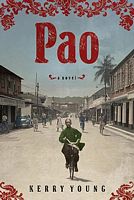
Book Review in Brief: Pao by Kerry Young

The eponymous Pao is only a small boy when he and his family emigrate from China to Jamaica in the wake of the Chinese Civil War and just prior to the outbreak of World War II.  After settling into the Chinatown area of Kingston, Pao grows up in its shadowy underworld and eventually becomes the civic-minded leader of its organized crime, doing business and protecting the Chinese minority in the city.  Using Sun Tzu's The Art of War as his conscience and guide, Pao's influence waxes and wanes against the backdrop of Jamaican politics, ranging from post-Colonial rule to Rastafarianism, from the Back-to-Africa movement to socialism.  

I've long been a reader of books of Caribbeana, particularly the fiction of the region, but this book gave me a wholly fresh perspective amidst the black African diaspora, white colonialism, and Indian subcultures that I've read before.  Race and class necessarily play a large role in this book, and while I wouldn't venture to say that Pao is a feminist, his dealings with women are largely well-balanced and even occasionally progressive for a man who is a product of his time and culture. 

To wit: Although Pao moves to Jamaica in 1938, the book opens in media res in 1945 when Pao  is beginning to earn his reputation as the go-to guy in Chinatown.  A  black Jamaican woman named Gloria comes to Pao to demand the justice that the law won't give her when a white sailor beats her sister almost to death.  Pao's brother urges him to drop the matter because the sister is a whore and, thus, should expect to get beaten up a bit from time to time, and further, that "white men been beating Jamaican women for three hundred years."  After much consideration, Pao's replies, "That is true, but this is the first time anybody come ask us to do something 'bout it." Thus marks the real beginning of Pao's unofficial career. 

While I didn't always like Pao, he is one of the most fascinating characters I've encountered in a long time, and seeing his trajectory from young boy to old man made for a satisfying read.  I'd recommend this book for readers interested in social stratification (class, gender, race), interesting character studies, or Jamaican politics. 

NB: I requested an ARC of this book from my MPS sales rep, Jen.  The book will be published  in the US by Bloomsbury as a paperback original in July of this year, but it is already available in the UK.  

15 December 2010

Review: You Know When the Men Are Gone by Siobhan Fallon

You Know When the Men Are Gone, a debut work from Siobhan Fallon, is a collection of loosely related short stories told mostly from the point of view of the women left behind at the army base of Fort Hood, TX, when their men deploy. (And yes, in this book it is invariably women who are left behind.) Unlike, for example Olive Kitteridge or In Other Rooms, Other Wonders, which are really more novels told in stories, Fallon's stories are more disjointed, and though the theme of waiting is carried on throughout, the effect is one of disconnect, which serves to highlight the alienation that all of the characters seem to feel.

Occasionally we get a man's perspective, but I found those narrative shifts a bit jarring, especially a story called "Leave," in which a soldier breaks into his own basement to stalk his wife during an unannounced leave because he suspects she has been seeing somebody else.  In "Inside the Break," a woman waits to hear whether her husband has survived an insurgent attack; delirious with worry, she logs into his email account and is bewildered to find evidence that he is not only alive, but is possibly having an affair.  Her short-lived relief takes on the ugly edge of suspicion, leaving her feeling worse than before. In another story, the reader learns why one widow avoids the Gold Star reserved parking--the words of gratitude and sympathy contrive to make her feel like she has lost her husband all over again.

Every once in a while, Fallon strikes literary gold with her insight into the double burdens of being part of a military couple, leaving me wanting to know so much more than the short story format is able to provide.  It makes me wonder how she might fare if she set her sights on a novel instead, really freeing herself into the lives of her characters instead of restricting her access in a short story.  I suspect that the longer form might be her strong suit and I look forward to reading more from her.

You Know When the Men Are Gone is forthcoming in January from Amy Einhorn Books, which is part of Penguin.  I received my copy from my sales rep, the lovely Karl Krueger, who raved about it to me and pressed it into my hands.  It's good, verging on the very good, and I think we can expect more work that is provocative from Fallon in the future.