14 June 2013

Harry Potter and the I Can't Believe It's Over Readalong

More fun than a poke of Pygmy Puffs.  More tears than Fawkes can fathom. That about sums up this splendid ride that Alice has taken us all on.  Thank you, madam, for hosting this misfit band of international readers. This series contains just about everything one can want in a book, and this last section for today's discussion is the most intense of all. There really is too much but we must try...

Let's start on a happy note, shall we?  Let's celebrate Neville's return:

  • But seriously: how many of you were also thinking in this first chapter, "Go on, Harry.  Tell at least Neville and Luna and Ginny what y'all are up to." Seriously, he's spent half the book being frustrated that Dumbledore never gave him the full picture, so why not rely on these most trustworthy of characters now that he knows the end is nigh?
  • I *love* the Ravenclaw password system.  But it's not very practical, is it? How would ickle firsties know how to answer the questions? Or do we suppose that the eagle door knocker adjusts its questions according to the person knocking?
  • Does anybody else find it strange that Harry abandons his trademark Expelliarmus for Crucio when he leaps to McGonagall's defense?  Not only is it going from a defensive to a completely offensive spell (pun intended), but going from a passive one to a very, very aggressive, not to mention illegal, one.
  • "The time has come for Slytherin House to decide upon its loyalties." I have always thought that this line was completely unfair.  Yes, you'll find me to be a Slytherin apologist, so clearly I will take sides here, but when in the course of the series have we ever seen the Slytherins get a truly fair shake when it comes to Harry and his merry band of Gryffindors?  No matter whether the Slytherin students support Voldemort or not, many of them are being asked to take up arms against their family members or to leave. They are the House that the remaining three houses loathe and make no secret of doing so. They are the House whose end of year House Cup was taken away from then at the last minute by the headmaster, the very person who should be maintaining more neutrality than even the teachers. If Hogwarts itself has shown no loyalty to the Slytherins, why should they choose otherwise? We as readers know all about Harry and what he stands for and his chance to save the world, but the Slytherins themselves are not privy to such information.
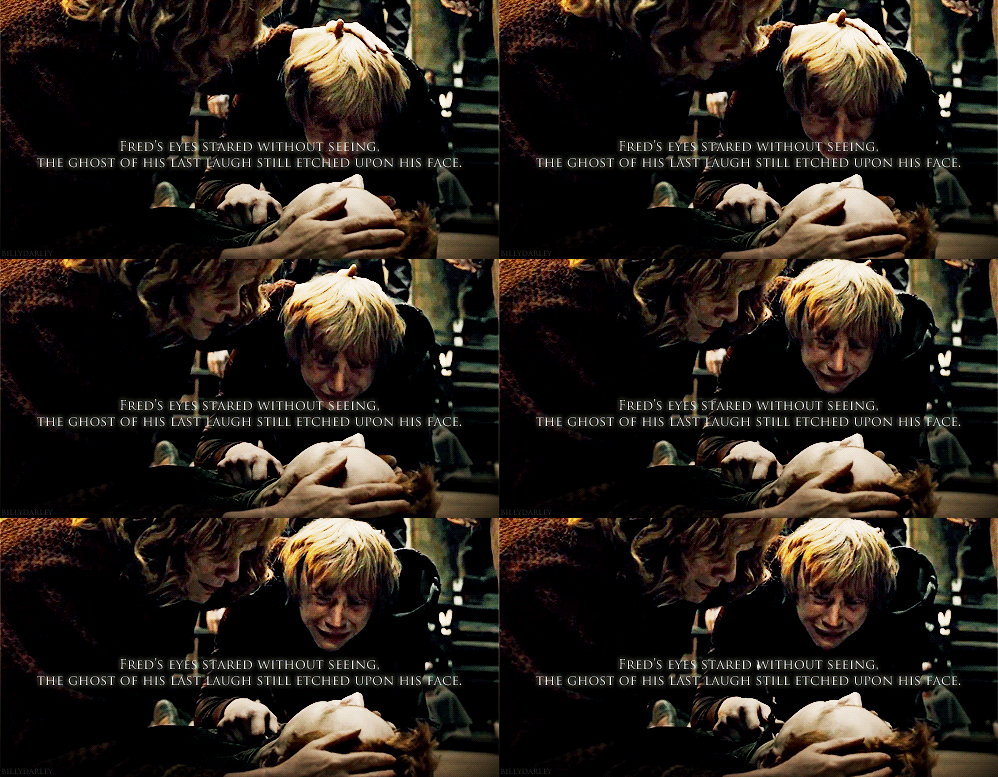
  • Percy's reconciliation with his family: brings me to tears every time, and oh, how I ache for them to have more time together before the Weasleys are rent asunder.


  • I love Harry's flash of insight about the no wizard in living memory to figure out about the diadem.  That was very clever of him, indeed, and a major leap in intuition. However, since he saw Voldemort in his vision thinking about where his horcrux was in the Room of Hidden Things a, why didn't they just go straight there to find the diadem?
  • These professors have some seriously whack ideas.  Bopping the Death Eaters on their heads with crystal balls?  That's just silly, but okay, I'll buy it.  But fighting Death Eaters with mandrakes?  Um, how is that going to work?  The Order and the students are all going into battle with earmuffs on, which is ridiculously dangerous? Otherwise wouldn't the mandrakes disable both sides with their screams?
  • I call shenanigans on Ron's ability to mimic Parseltongue well enough to break into the Chamber.   It was quite brilliant of him to think of the idea, but I'm just not buying it. 
  • Ooh, Fiendfyre. Very interesting.  Did anybody notice that in the film, the Fiendfyre takes the forms of the four House mascots? I did not notice that until I started looking for gifs.  
  • And in other news, we finally see Drarry on a broomstick together.
  • Okay, wow. Snape gets the most ignominious death EVER. I assumed for a long time that he would have to die to satisfy the story arc, but I really, really, really was hoping for something more badass than that. Just sayin'. 
  • Frankly, Dumbledore, YOU disgust me. I have a whole essay about it here that I wrote back in 2011. But here are the most relevant parts: Like many people, including Harry himself, I was surprised to learn of Dumbledore's past, but rather than being disappointed in him, it made him far more interesting in my eyes.  Hard-won wisdom, experience, and self-knowledge make for a better character any day in my book (and make me curious what we would learn if given a glimpse of, say, Gandalf's youthful indiscretions).  It's no wonder, then, that in books 1-6 and the backstory we get there that Dumbledore comes across as powerful, wise, and good--it's because he has spent decades reflecting on his past and honing those worthy qualities in atonement.
    So why on earth does he not treat Snape with the compassion we would expect to see in those pensive memories?  After all, we've just learned that 18-year-old Dumbledore was best friends (we find out later from Rowling after the series has been published that they were probably lovers) with Hitler Grindelwald, that he subscribed to his plan for the master human wizarding race ("Muggles forced into subservience" is a direct quotation), and he was quite ready to throw over his own siblings and follow Grindelwald's hallows hunt--not to mention he possibly killed his own sister.  So it felt like a punch to the solar plexus for older-and-wiser Dumbledore to say to Snape, who in 1981 could not have been older than 21, "You disgust me."  Really, Dumbledore?  Snape disgusts you?  For wanting the only person he ever loved to be kept guarded from Voldemort?  Because he didn't automatically beg to save James Potter, the boy who nearly got him killed a few years earlier but was only given detention for it because *you* didn't want to let the wizarding world know you had allowed a werewolf into Hogwarts?  Frankly, Dumbledore, you disgust me for saying that when at almost the same age you were fucking Grindelwald, subscribing to his anti-muggle policies, and wanting to bring back your dead mother so she could watch over your younger siblings and relieve you of your adult responsibilities. To exaggerate slightly and put it more bluntly, Dumbledore was well on his way to becoming one half of a two-man Death Eater Squad team, all in the name of The Greater Good, and yet in his older & wiser years isn't able to empathize with Snape's youthful mistakes?!

    [sidebar: why couldn't Dumbledore have just been gay in the books instead of being outed after the last book had been published? I do not think lowly enough of Ms. I'm-Wealthier-Than-God Rowling that she was worried that she wouldn't sell as many books if a main character were gay, so what was the reason?]

    And as if that weren't enough, Dumbledore makes a second knife-thrust to the heart when he says "Perhaps we sort too soon." Why, Albus?  Because Slytherins are second-class citizens?  Incapable of doing good in the world?  Because only Gryffindors can be brave?  Because Slytherins, unlike Gryffindors, don't deserve a second chance when they recover from their adolescent foolery?

    It's not that I don't respect Albus for his teenage failings.  We all do things in our younger lives that as adults we are not particularly proud of, and we commit acts in pairs or groups that we wouldn't dream of doing on our own.  In fact, Albus's dabbling with anti-muggle policy in his youth makes him a far more interesting character in my eyes, and I admire his fortitude and redemption in later life all the more.  Which is why I cannot forgive his lack of empathy towards Snape in these pensieve memories.  If it's because Snape reminds Albus of his own teenage self, then it's all the more reason for me to want to bitchslap  ol' Dumby.

  • Ahem.  I digress.  "I open at the close." Very poetic. I love the scene of Harry with his color guard on the way to his death.  I mean, it kills me, but I love it. I love it for its own merits as well as because it reminds of the scene in The Lion, the Witch, and the Wardrobe where Aslan is walking toward his own death, accompanied in the cold of the night by Lucy and Susan.  And then when Harry asks, "You'll stay with me?" and James responds, "Until the very end," I totally lose it.  It's a lot like this:

  • And because it just wouldn't be a Harry Potter readalong without it, I must draw attention to one of my favorite "wand" references: "He picked up the holly and phoenix wand and felt a sudden warmth in his fingers, as though wand and hand were rejoicing at their reunion." Yeah, I just bet they were. 
  • Neville has his moments of awesomeness. Narcissa Malfoy has her moment, too, and though it's less awesome, I want more than ever her back story.
  • That epilogue. I. Can't. Even. I know y'all are rolling your eyes at me by now, but I have a really good fanfic downloaded called Coda to an Epilogue: 20 Year Later, or the Kids Are All Right.  It's about 90 pages long, so I cannot post it, but I can email it. Let me know if you'd like me to send it to you. It's completely canon-compliant as far as I recall, and it puts closure on the wizarding world in a way that JKR's epilogue does not: Young James Potter acts a lot like his eponym, young Albus Severus gets sorted into Slytherin and becomes best friends with Scorpius, and Draco marries a tough freedom fighter from Portugal.  Plus sewers and alligators.  And lots of humor.
  • I am so sad that the end is here for this readalong.  I think, above all, that is the main reason I read fan fiction--it allows me to linger in this world a little longer.  Thank you, JKR. Thank you, Alice.
  • This YouTube video is a little long, but it's a good way to bid Snape adieu. 


07 June 2013

Harry Potter and the Deathly Hallows: Wowzer!

Kudos and props and ALL THE HUMMUS to Alice for hosting this read along!  It's been about three weeks since my last participation, between my skipping two weeks ago and getting a respite for BEA last week.

Oh, my goodness.  There is too much in this week's chunk.  Entirely too much. Partly because I want to draw out this readalong, partly because it's true that it's just too much (yeah, I'm repeating myself), but I think we should take the remaining reading and discuss no more than two chapters at a time.  Because otherwise it will feel like this:

Chapter 20-21: Xenophilius Lovegood. How terrible must it be to be in his position? I feel very sorry for Mr. Lovegood, and I really have no idea what I would do if my only child were being held by sadistic kidnappers. I hope I'm never in the position to make judgement calls re: the greater good when the stakes are that high. I am fairly certain that if I'd read Harry Potter as a much younger reader I would never have identified with Xeno's dilemma, but now, while I clearly want the trio to escape, my heart still aches for him a little. Which is all to say that the series is a little different each time one encounters it.  I nitpick along the way because I'm snarky I love, but I have to deeply admire the fact that somebody wrote a book that speaks as much to teenager as it does to me.

But seriously, how can he not know that that's an erumpent horn? The man can't see the forest for the trees.  And show of hands: how many people crumpled all over again when Harry saw the ceiling in Luna's room? I know I did.
found here
Two things: how did the trio not know something was up when Luna didn't immediately come to the house and welcome them? I shake my head at them. Also, how 'bout our girl Hermione's quick thinking there at the end of this chapter?  Brava!  I think in this book she really comes into her own in terms of her intelligence and wits.  Books 1-6, she relies almost exclusively on book learning and her prodigious memory, but here in book 7, she's showing a depth of creativity in the face of necessity that is both impressive and powerful. When the coming years give her the experience and maturity to match that intelligence and power, she's going to be one seriously amazing witch to reckon with.

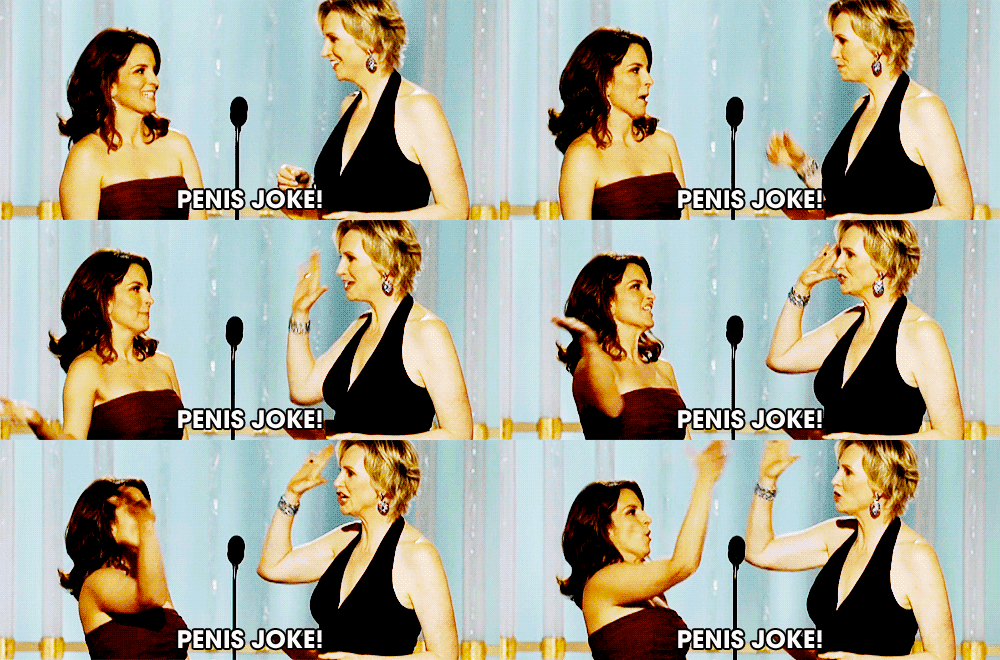
And because no situation is so dire that we can't appreciate a little penis humor: "I've got an unbeatable wand, come and have a go if you think you're hard enough."

Chapter 22: How does the password work on Potterwatch? Do you randomly turn the dial on the wireless at random times and shout out random passwords in the hopes that Potterwatch is airing? Because that just doesn't seem plausible at all.  While we're at it, why do Kingsley and Remus think that Royal and Romulus are good code names?  River works for Jordan, as presumably most wizards aren't well-versed in biblical things.

Chapter 23: Hermione displays her quick brilliance once more by making Harry almost unrecognizable.

I'm not sure this occurred to me during previous readings, but it did this time: does anybody else find it odd that Grindelwald is still alive? Now that I think about it, I'm a little taken aback. And this little detail never stood out before, but Grindelwald lies to Voldemort about never having the Elder Wand. Dare we suggest that it's remorse that makes him say so?

I feel terrible for Draco in this chapter.  It's clear that he doesn't want to betray Harry to Bellatrix, but he's caught in an awful place, knowing what will happen to him and his parents if Voldemort learns that he was less than forthright.

And what the heck kind of dark magic makes Wormtail choke his own daylights out? Can I just say here that I was pretty disappointed how the life debt was repaid. Before this book was released, I was convinced that Wormtail would use his silver hand to protect Harry from Grayback, which I think is actually more interesting and poetic, tying it back in to the days of the Marauders.

Chapter 24: I just need to say that I have no great love for Dobby, but all the same I'm extremely moved by his death. I mourn his loss.  But unlike Dumbledore's death previously that left him adrift, Dobby's death seems to galvanize Harry and lend him insight in the infernal hallows vs horcruxes debate. I see Dobby's death as one more turning point and the real beginning of the end, as Harry's thinking becomes more intuitive, making leaps ahead of even Hermione, a pattern that will continue right to the very end of the book.

Penis subtext joke: I'm sure by this time that nobody is surprised that Draco's wand "felt friendlier in his hand."

Chapter 25: I'm not going to take a stance here, but in this chapter and the next we get most of the bases for all of those anti-Semitism essays floating around the interwebs. Griphook is an interesting character but not an entirely pleasant one.  I don't actually think JKR is actively anti-Semitic, but I do think that it's fairly careless of her to employ so many stereotypes. Oops, looks like I just took a stance.

I cannot tell how much in this chapter is JKR showing what assholes wizards can be to non-wizards and how much is JKR not realizing that her characters can be assholes.  Authorial intent, how I love thee!  To wit: why should Griphook be expected to eat the food of a different species? Presumably Fleur wouldn't feel huffy if a centaur or a mermaid were staying with them and wanting non-human food.

Why, Harry?  Why are you trying to double-cross Griphook? There's no need to be so underhanded.  Tell him that you need the sword long enough to destroy something, which will weaken Voldemort to the point that he can be killed.  Once the killing's done, the sword could be his. It's clear that Griphook respects Harry and finds him to be a wizard with extraordinary views, and I still say that would have been his best bet.

Chapter 26 & 27: This is one of those occasions when the movie is so much more fun: Helena Bonham Carter playing Hermione playing Bellatrix.

Also, that curse in Bellatrix's vault? That's crazy in wildly inventive and effective kind of way. Flagrante, indeed.  But why couldn't they just use impervio? And if anything that gets touched replicates itself, why doesn't the cup create another half dozen horcruxes?  Magical loopholes.

Chapter 28: Oh, Aberforth.  I can't tell if he's truly given up, or if he's just being a big ol' curmudgeon. How sad about Ariana. But JKR must have been playing a very long game, indeed, for all of those goat references to have worked out.  I wonder if she knew back in the first book whether Aberforth's patronus would be a goat, etc.

Also, it's about damn time that Neville is back on the scene. I am already all a-flutter about next week, in which I will have ALL THE THINGS to say about Severus Snape and Dumbledore and that infernal epilogue. But to end on, a little something funny because frankly, we need it:

05 June 2013

Audio Book Review: My Beloved World by Sonia Sotomayor

As I mentioned in my last audio book review, I've lucked my way onto a special list from Random House Audio, and I have to say that listening to Sonia Sotomayor's My Beloved World was as pleasant a surprise as I've ever had in my audio book experience.  I never would have picked this book up to read, much less purchased the audio book for myself, which in retrospect makes me something of a fool.

This book was everything that I had hoped Maya Angelou's memoir would be and wasn't: immediately engaging, beautifully read, and exceptionally written. If I had been reading this book instead of listening to it, there would have been much underlining and dog-earing of pages to mark the lovely passages.Rita Moreno performs the audio and she is definitely one of the better readers I've ever listened to.  The prologue is read by Sotomayor herself, and while it's nice to hear her actual voice, Moreno was definitely the perfect choice for reading the rest of the book.

I suppose I shouldn't be surprised that a Supreme Court justice can write well, but I was.  Good writing isn't usually a hallmark of memoirs with a political bent, and so many lawyers I know run on at the mouth without actually saying much, that it was actually a double surprise. I particularly enjoyed learning about her younger years up through her time at Princeton and the various struggles she faced along the way. There was the rare occasion when I felt that Sotomayor, in summing up the end of a couple of chapters, was a tad too didactic, but overall this was just terrific.  Underdog stories are good, and hers is certainly one of the great underdog stories of our time. I highly recommend it to anybody interested in memoir, strong women, feisty characters, the immigrant experience, minority rights, or simply a damn good story. 

28 May 2013

Help Me Choose Some Vacation Reading!

Lovely Long Bay on Anguilla
I've got my annual Caribbean vacation coming up, and while I've been traveling to the islands often enough that I could practically pack in my sleep the night before leaving, one thing I spend lots of time agonizing over is which books to take with me. This year I'm also armed with an e-reader (Kobo Glo), which I plan to load up with some galleys, but I will also be packing a hefty number of physical books for our two week vacation. Yes, I can pack my snorkel gear and clothing sufficient for two weeks into a rollaboard suitcase, but I check another bag filled with books.  That's just the way I roll.

We're going to Anguilla again this year, an island we feel we're coming to know, little by little, after multiple (six? seven? I lose track) trips. We love this little place in the sun and we love our daily patterns there: read, eat, walk the beach, read, eat, swim, read, eat, snorkel, read, eat, explore. Repeat for the next fourteen days. Intersperse rum drinks at will. We love Anguilla for what it isn't (loud, crowded, jetskis, nightlife, casino) just as much as we love it for what it is (peaceful, quiet, friendly, beautiful beaches, and amazing food).

I'm a little behind in pre-reading my books for vacation.  No book makes it into my suitcase without my reading at a minimum the first two chapters to ensure its worthiness.  I used to read only the first chapter but last year I got landed with a couple of duds, and then some writing friends revealed to me that the first chapter is the most-revised and workshopped and often the best part of any book. Of course.  But that's where you come in, dear reader.  If you've read anything on this list that you think was excellent or a dud, please enlighten me.  Likewise, if there's a book out there that really blows your skirt up or creams your  Twinkie or [insert euphemistic metaphor of your choice here], please let me know.

I try to take books that are mostly not-yet-published, and they will mostly be fiction, but I try to work at least one YA, one short story collection, 1-2 works of nonfiction, and occasionally one classic into the mix for variety's sake. If a book will also double as a must-read for my husband it gets bonus points and an almost ironclad guaranteed spot in my bag.  Here are the ones on my long list:

For nonfiction: Gulp by Mary Roach, The Turk Who Loved Apples and Other Tales of Losing My Way Around the World by Matt Cross, and Headhunters on My Doorstep by J. Maarten Troost (I LOVE his books on the South Pacific.  His book on China didn't do much for my skirt OR my Twinkie, though). The latter is almost guaranteed a spot because (1) it isn't published yet and (2) my husband loves his books, too.

Vying for the short story position(s) are: The News from Spain by Joan Wickersham, This Is Paradise by Kristiana Kahakauwila, and The Peripatetic Coffin by Ethan Rutherford.

My fiction offerings are pretty varied: Mo Said She Was Quirky by James Kelman, Happiness Like Water by Chinelo Okparanta, A Beautiful Truth by Colin McAdam, The 100-Year-Old Man Who Climbed Out the Window and Disappeared by Jonas Jonasson, The Girl You Left Behind by Jojo Moyes, Claire of the Sea Light by Edwidge Danticat, and The Lowland by Jhumpa Lahiri. And I'd be remiss if I didn't include Lamb by Christopher Moore.  Then there's anything I might pick up at BEA this week. The new Bill Bryson if I'm lucky.  Or possibly the new Paul Harding or Marisha Pessl.

My classic this year just may be The Grapes of Wrath by John Steinbeck.  This is the book my husband asked me to read for Christmas in 2012.  We do this every year--we read a book of the other's choosing--and while I love this tradition, I am a little bummed that this is the book he picked for me out of all of the fantastic books he read last year. However, I may put off reading Grapes and take with me something a little more fun: Zelda Fitzgerald's Save Me the Waltz, for example.

My YA options are wide open.  I had been planning on taking Code Name Verity, but it turns out that my bookstore just started a YA bookclub for adults and that's the first selection, to be discussed before we leave.  So that one is out.  The last few YA books that I went crazy for were The Fault In Our Stars by John Green, The Last Dragonslayer by Jasper Fforde, and Eleanor and Park by Rainbow Rowell, so I'm open to most things: realistic, historical, or fantastical.

So what say you, gentle reader?  Which books should earn passage to Anguilla?
This is a photo from our "home" balcony on Anguilla

27 May 2013

Audio Book Review: Mom & Me & Mom by Maya Angelou

I am very lucky to find myself on some sort of magic mailing list from Random House Audio--I don't know if it's because of my audio book reviews, or regular book reviews, or because a sales rep somewhere down the line put my name in for them.  But every couple of months I find myself receiving a box of four random books on CD, if you'll pardon the pun. One of the best parts so far is that they have all been audio versions of books I would not otherwise have chosen to purchase or read.

One of them was Maya Angelou's memoir, Mom & Me & Mom. It's a fairly short production, unabridged but only 4 discs long, and read by the author herself.  Once upon a time, back in my first year of college, I think it was, I read I Know Why the Caged Bird Sings for a class, but that's about the extent of my knowledge of Maya Angelou, at least until now. I didn't even know how to pronounce her name correctly; up until this listening, I had pronounced the last syllable of her surname as if I were saying "skip to my Lou," when actually it's supposed to be pronounced like "swing low, sweet chariot."

I had no idea she has led such an extraordinary life, one marked by some truly horrifying moments as well as blessed ones. The strength of her character, as well as that of her mother and paternal grandmother, are clear from the onset in this book. When she was only three, Angelou's mother sent her and her older brother to live with their paternal grandmother, and this book is largely the story of their relationship and eventual reconciliation after Angelou and her bother return to live with their mother while in their teens.

It's unusual enough for a mother and her near-adult child reconcile and reach a place of deep respect and commitment to each other after a prolonged period of abandonment, but that's just one of the wondrous things revealed in Angelou's memoir. Thank goodness, because it helps to balance out, at least a little, the two most terrible things that happened to Angelou in her life: being raped as a young child and later being abducted and beaten almost to death by a lover whose jealous rage pushed him to the brink of insanity.  If I gloss over these things lightly, it is not to be glib, but to intentionally follow the author's lead, who deals with these things in a very matter-of-fact way in this book.

I would love the chance to listen to Maya Angelou tell a story without reading it from a script, as there were times during the listening to this book when I mesmerized by her cadence and other times I was brought up short by how unnatural and choppy it felt, with pauses in places that really made no sense. I don't always, or even often, think that the author is the best reader for any audio, and I think that holds true here. But every now and again there were moments of listening transcendence.  I just wish she had been more consistent, and I have a hunch that anybody who knows Angelou and can listen to her stories unfold as the words occur to her would be privileged, indeed. I'm very happy that I listened to her story of her mother, and I find it to be one of uncommon generosity and respect. 

17 May 2013

Harry Potter and the Deathly Hallows: Part the First, In Which I Go Crazy With Wand Innuendos

Ho, boy.  It's harder than I thought it would be to coalesce my thoughts this week.  I think Deathly Hallows is a pretty good book but a pretty poor wrap-up to the series, but I'm not sure that anything could have wrapped up the series brilliantly for me--my expectations were always going to be too high. The whole time I was reading this week, I kept thinking, oh, not much longer.  Or, wow, we won't see ______ again.  I'm feeling pretty melancholy and the worst hasn't even happened yet.  But onwards and upwards.  Thanks once again to Alice for hosting the readalong, without which I'm sure I'd have got lots more reading done but had much less fun.

I think this is the first book where JKR used any epitaphs.  I am not a fan of that.  I do love the dedication, though. And it's curious to me that it looks so serpentine. Is it a subtle nod to Slytherin? Or an even subtler nod to the Mouse's Tale/Tail from Alice's Adventures in Wonderland? I'd really like to know.

Chapter One: Snape is literally and figuratively Voldemort's right-hand man. Love that. But then we hear about Pius Thicknesse and methinks that JKR has grown a tad heavy-handed with her Name Symbolism once more.

She makes up for it when Voldemort and Malfoy compare the length of their wands, though.  Makes Lucius's "involuntary movement" all the more intriguing, no? And then "some of the throng sniggered." They certainly did, Jo.

Not my original idea here, but I remember reading a pretty in-depth review of DH after it came out, saying that in the first chapter, Rowling really ratchets up the fear and tension by killing off a character so beloved that...we never knew her name before now. When I first read the scene of Charity Burbage, I was pretty subdued, but every subsequent time I've read it, I can only think of what that critic said and it makes me giggle.

Chapter Two: In Memoriam.  Maybe this chapter would have been better named In FoDump.

Chapter Three: I got nothin'. I really had wanted a better reconciliation of Harry and Dudley, and there were glimmers of it, but I think there's an enormous story there just waiting for JKR to tell it.

Chapter Four: I like the action-y bits in this chapter, but it all kind of leaves me wondering why they couldn't just, oh, I dunno,  drive Harry out of harm's way instead of creating this ridiculously complicated diversion. They could have put lots of Shield Charms on the car. Dumbledore wanted Snape to still be useful to Voldemort? Dude, Snape just killed you to be useful to Voldemort. No need to get Moody killed in the process. Besides that, why not Disillusion themselves when leaving Privet Drive?  They did that when arriving there and it seemed to work just fine.
Wait, you want to use polyjuice and risk everybody's life instead of just driving away in a muggle car? Riiight.

Also, the same critic who wrote that about Charity Burbage brought it to my attention that at one point there are six naked Harry Potters in the room, waiting for clothing. Just sayin'.

I was upset when Hedwig died.  She dies a better death in the movie than in the book, though.

Chapter Five: I love the twins here. Getting an ear cursed off and still making bad jokes about it. The twins are really at their best in this book, I think.
Hole-ier than thou. 
I'm sorry, but an editor should have caught this one: "The suddenness and completeness of death was with them like a presence." In other words, it was with them like something that was with them. Yup.

Chapter Six: Anybody else surprised by the way Secret Keeping changes with the death of the Secret Keeper? I would have assumed that charm/spell/whatever would end with the death of the Keeper.

Also, Ron is at his best in this section of the book.  His humor is quick and the tone is just right and he seems to have gotten a grasp on the different ways he can be a friend to Harry vs Hermione.  I chuckle every time I re-read his "always the tone of surprise" line. And his response to Hermione's saying that if she were to drive a sword through him it wouldn't damage his soul: "Which would be a real comfort to me, I'm sure." Oftentimes in previous books Ron's humor has a bitter edge or is at someone else's expense--usually Luna's or Neville's.  But I really like Ron in these first ten chapters, and he's not a character I generally am partial to.

Chapter Seven: Twelve Fail-Safe Way to Charm Witches...about which Ron adds,"It's not all about wandwork." No, indeed, Ron.  No, indeed.  Tee hee.

Chapter Eight: Krum hadn't realized that he'd ever discussed his wand with fans before.  You cheeky Seeker, Krum!

Chapter Nine: In which Hermione is essentially the most awesome character ever but then claims never to have done any memory charms. One chapter after telling us that she's performed complex ones on her parents. Editors should have caught that, too, but like Helen of Troy's face, it's a line that has launched a thousand "ships."  (Most adult Hermione/Snape stories incorporate that line and have Snape perform the memory charm on the Grangers.)

And then Ron struggles with his wand and tells Hermione that it's no wonder he can't get it out.  With Harry standing right there and everything!

Chapter Ten: Oh, thank GOD they finally figure out who the heck RAB was. Now we know was Narcissa didn't get a star name like the other Blacks--it's because her cousin Regulus got two.  Oh, and yeah, they finally remember that locket from OotP that they mysteriously couldn't open.

Oy, my goodness, Kreacher's tale.  So heartbreaking.  One of the most poignant part of the entire series, I think. My eyes are actually welling up right now, just thinking about what I read yesterday. So emotional, so right on the money in terms of Hermione's analysis of house elf motivation and loyalties and what bastards wizards are for treating house elves the way they do.

Heckuva chapter to end on, I say. 

10 May 2013

Tales of Beedle the Bard

All hail, Alice, host of the bestest readalong, and her ability to make us all stick to deadlines like good little Hufflepuffs. It really has been a ton of fun, and I appreciate the emotional breathing room she's given us between tomes 6 and 7.  But it must be said that reading Tales of Beedle the Bard has left me feeling siriusly underwhelmed. See what I did there?

In fact, this is how I felt about reading them:

Very shruggy.  I mean, part of the point of fairy tales is that there's no real character development--they're supposed to be blank enough for Every Reader (or in some cases, Every Listener) to be able to read a little of himself or herself into them. And to be fair, I've gone back and read some of the Grimm tales in recent years and didn't love them either.

But do you want to know what really bothers me about this book? Well, quite a lot, actually.  But one of them is the bogus 4th wall play that JKR does with her annotations for Muggle readers.  And another of them is Dumbledore's annotations to begin with.

For starters: If these tales, which must have been old when Beedle managed to write them down, were so progressive in terms of gender equality, why, 600 years later, does Slytherin not have any female quidditch players?  Why do witches still stay home and do the child-rearing while their husbands go off to work in the ministry?

While I don't think I would be able to sit through a reading of Mrs. Bloxam's expurgated version of "The Wizard and the Hopping Pot," the few excerpts Dumbledore included in his annotations filled me with glee--there are so many good words in there: "poorly tum-tums," "teethy-pegs," "kissed and huggled," etc. And you can't tell me that Hoppity Pot isn't a better name than Hopping Pot.  Considering Dumbledore's own few words of nitwit, oddment, and tweak, I'm surprised he's not more drawn to this version himself.
One of the more benign images from googling "teethy peg"
Did anybody else think that Babbity Rabbity's Cackling Stump was going to be a story about an amputee? Back when I read Deathly Hallows, where Ron is naming various tales to Harry and Hermione, utterly astonished they've never heard of any, this was one of them, I thought that and was kind of hoping for it.  Like an olden-days version of Mad-Eye Moody, whose pegleg talks back to its owner.

I also wanted to pull my hair out re: the deathly hallows re: Dumbledore's purely Byzantine machinations with those in our upcoming book to be discussed. Deathly Hallows, thy name is Red Herring. Just like communism.

And what's up with the Malfoys being badmouthed all the time? JKR, you could make your names a little less heavy-handed and it would be more effective. Brutus Malfoy? Really?

Anyway, I'm glad that net profits from this book go to benefit some children's fund or other, but honestly, this book seems to be the equivalent of Meryl Streep filming "She-Devil" because she needed some beer money. In other words, it's not quite up to the standards I usually associate with JKR's stories.
See what I'm saying?

03 May 2013

Harry Potter and the Half Blood Prince Readalong

His dumblin' days are sadly numbered. I can hardly think about it.
There is so much happening in the last quarter of this book that I hardly know where to start. Except, of course, by thanking Alice for hosting this readalong.  If anything has been made clear during my participation, it is this: despite our collective nitpicking about contradictions and inconsistencies and our tendency to bicker about our beloved characters, this is a magical, magical world that JKR has created.  It is not, perhaps, world-building on a Tolkien scale, but it is still the world I most want to dwell in when I want to escape from this one.

And now, on to Chapter Nineteen: Elf Tails: it's interesting to me that Hermione is the first one to analyze the two different attacks on Katie and Ron and peg them for ultimately being the same.  She may not excel in creative magic like the twins do, but her mind is sharp and logical and she doesn't get distracted by dissimilar superficial details. It's Our Girl at her best.

Same chapter: Mr Weasley says it was a lucky day that Ron sat with Harry on the Hogwarts Express, but really, isn't it just the opposite? Would half of the Weasley's troubles exist if it weren't for Ron's close association with Harry? Would Harry have even been sorted into Gryffindor if he hadn't made friends with Ron on the train? Still, good on Arthur Weasley for being a glass-half-full kind of guy.

Same chapter: I'm sorry, but couldn't a 5th grader have found a loophole around the instructions Harry gave Kreacher? Harry didn't tell Kreacher that he couldn't tell, say, Bellatrix or Narcissa, that he (Kreacher) was following Draco.

Chapter 21: The Unknowable Room. I'm curious about Harry's and Snape's disagreement on the best way to tackle dementors.  Harry = producing a patronus and Snape = occluding? That's my hunch.

Brief detour to the Drarry sexual subtext: Draco calls Harry the Boy Who Scored, Harry later says under his breath multiple times, "I need to see where Draco Malfoy keeps coming secretly" and "I need to see what Draco Malfoy is doing inside you." Yeah, baby.

Chapter 23: Horcruxes. I wonder, not for the first time, why it's only murder that can split a witch or wizard's soul.  It's terrible, but it doesn't seem like the worst thing to do to somebody.  Seems like what Bellatrix & Co did to the Longbottoms was worse. And is it just the act of murder that splits the soul, or is that additional creation of a horcrux that does it?  And where does killing leave off and murder begin?

Chapter 24: Sectumsempra.  Does anybody else find it disturbing that in the same chapter in which Harry slices open Draco Malfoy and nearly kills him, that he finally gets Ginny Weasley? Way to reward your characters for brutality, Jo. On the other hand, the monster in Harry's chest at the end of this chapter inspired THE best pieces of fanfiction I've ever read: The Way We Get By and Drop Dead Gorgeous, by Maya/Mistful, aka Sara Rees Brennan.  If you can find them anywhere on line, I recommend that you do so.

Chapter 26: The Cave. Very cool, very creepy, but unnecessarily complicated, perhaps?  Could they have flown on brooms to the middle of the lake? Couldn't Harry have shot the aguamenti'd water straight into Dumbledore's mouth? Couldn't Dumbledore have taught Harry a quick spell to produce fire when he was conversationally telling him how they would keep the inferi at bay?

But oh, my hear melted the first time I read Dumbledore say, "I am not worried, Harry...I am with you." And then every subsequent time I read that, my heart just broke, because of course I knew what was coming next.

Tarot card: The Lightning Struck Tower
Chapter 27: The Lightning Struck Tower.  There's a lot going on here. Besides the obvious, I mean.  It breaks my heart a little bit that Draco has had such a tough year that the sympathy and praise he gets from Dumbledore mean so much to Draco. What a terrible position to be in: forced to plot your way to kill one of the greatest wizards of your time, with pain of death hanging over you--not just yours, but your entire family's.  I imagine Draco would have been in much better shape if it was only his own life on the line. Poor Snape, because the moment he's been dreading all year finally arrives. If Dumbledore is correct, then Snape believes he is splitting his soul to keep Draco's intact. Poor Harry, to be invisible and petrified the entire time.

Poor Draco
Chapter 28: The Flight of the Prince.  I don't understand how anybody who has ever read any kind of story with a red herring before could still think that Snape was evil after reading this chapter. Snape is fleeing for his life with Draco and he still is trying to teach Potter, still trying to protect him. I remember reading this chapter the first time, in the wee hours of the morning, feverishly turning pages, re-reading the scene on the tower and then this one, going back & forth between the two chapters. Comparing the "revulsion and hatred" from one scene with the "demented, inhuman" look on his face, the pain visible there compared to the pain of a dog being burned alive.

Chapter 29: The Phoenix Lament.  I'm mostly fine until I get to the scene when Fleur and Molly arrive in the hospital wing and have their moment. Then I cry and cry.  I have neither really liked nor disliked Fleur, but at this moment I love her. "What do I care how 'e looks? I am good looking enough for both of us, I theenk." Indeed you are, Fleur.  Indeed, you are. But can I just say here how much I hate the inconsistency of Fleur's speech?  Sometimes she is capable of pronouncing a"th" or "h" and sometimes she is not?

Ach, I am out of time.  But this book leaves me with an ache that the others don't, and not for the obvious reasons. No, instead I'm left wondering how and when the Snape/Harry story arc will be resolved, because in HBP, it's clear to me that theirs should have been the most important relationship in this series.  And I don't mean that just because Snape is the most interesting character, but because of all of the layers of the story that would wrap up if they came to a true reconciliation. A reconciliation between Snape and Harry is a reconciliation between generations, it's a righting of past wrongs, it would come from a place of understanding instead of blind prejudice, and oh, shoot, I really am out of time and can go no further.

I'll just say this: that if you think Snape is as interesting a character as I do and would like to read some excellent fanfiction that beautifully addresses the Harry/Snape issue, please read Theowyn's Harry Potter and the Enemy Within. It's not slash, everybody stays in character, but it's a thoughtful exploration of the student/professor relationship and, to my mind, a better story for Harry's sixth year than HBP was. 

02 May 2013

Book Review: Americanah by Chimamanda Ngozi Adichie

One of the best books I've read in the last decade was Half of a Yellow Sun by Chimamanda Ngozi Adichie, published in 2006 and recreating a period of history about which I knew nothing, much to my shame: the Biafran war for independence in Nigeria. When I heard that Adichie had a new novel coming out this spring, I was very excited by the news.

It's difficult to compare Adichie's seminal novel with Americanah, her latest effort. This is a contemporary novel, splitting its time between Nigeria and America, with a brief and depressing detour into England for good measure. The writing is always good and frequently transcendent, and that's not an adjective I use lightly. It is a third person narration that mostly follows Ifemelu, a bright young Nigerian woman who jumps at the chance to study in America; after finding much struggle she finds both personal and professional success, but something still eludes her, so she returns to Nigeria.  We also get a portrait of Obinze, the boy from university who loves Ifemelu but loses her through no fault of his own, and his subsequent sojourn to London as an illegal immigrant.

The third person narrative feels so intimate on occasion, though, that I had to double check and assure myself that it was not first person--that, as much as anything, is the true measure of how fine a writer Adichie truly is. She does everything right, as far as I'm concerned, and writers who are (lazily, in my opinion) compelled to write in first person, or use multiple narrators to tell their story, or worse, do either of those things while writing in present tense, could learn much from studying her prose and structure.

The first half of this novel is truly substantive, whether it's dealing with power and corruption in Nigeria, or the vagaries of racism in modern America. Adichie made me think of race in new ways while I was reading this, and of course her discourses on American Blacks vs Non-American Blacks (told via Ifemelu's blogposts) were fascinating and illuminating in equal measure. Whether it's Ifemelu's complicated relationships with her auntie, cousin, and boyfriends in the US, or with her family or Obinze back home in Nigeria, or whether she's casually expositing about race in America compared to a lack of race awareness in Nigeria, I found the first half of this book satisfyingly meaty--something I could really sink my teeth into.  Whether I was reading the book over breakfast, on the airplane,  or in a cafe in the French Quarter, I was immersed and loving it.

The second half of the book, however, is a bit of a disappointment, I'm sorry to confess, but that may have more to do with my expectations than it does with any real failure of the book. Once Ifemelu repatriates to Nigeria, and once her path crosses with Obinze's again, the book becomes much more about relationships than anything else. While I was expecting Great Things, hoping that Ifemelu would use her Life Experience to strike out on her own, raging against the machine for the rights of the downtrodden, she was mostly concerned with reuniting with Obinze, who in her absence, had married and had children.

The book ends with (Spoiler alert: please highlight the following text to read it) Obinze leaving his wife to be with Ifemelu, which gives the novel a tawdrier ending than I would have liked.  I had no objections to their being together--in fact, I tend to root for happy relationships in fiction--but what I really wanted was for the novel to continue beyond that point, to tell me what extraordinary things they had done with their lives. I wanted to know that they used the strength of their combined love as a fulcrum to move the world and be a force for good, as they had been on their own in their separate lives. 

Still, I want to make it clear that I was drawn into this novel emotionally in a way that I haven't been with the past few pieces of literary fiction I've reviewed. Adichie's writing is terrific, and a book like hers, even one whose ending disappoints, is still about a thousand times better than most of the drivel that gets published.

NB: This book has already been published in the UK and will be published by Knopf in the US on May 17, 2013.  I read an advance reading copy provided to me at my request from my sales rep.

01 May 2013

Last Month in Review: April 2013


I saw this gif a few weeks ago while searching for the perfect Harry Potter gif for Alice's readalong. It's no more appropriate now than it was for Harry Potter, but it's so cute I had to use it.  Found it here, but I don't think it's her image, either.

April was an entirely average reading month for me: a little fiction, two works of non-fiction, some audio books, some fan fiction, and even one e-book.  I am thankful because I think my temporary reading slump is behind me. In chronological order:

1. Americanah by Chimamanda Ngozi Adichie. Excellent work of literary fiction.  Slightly disappointing ending.

2 & 3. The Way We Get By and Drop Dead Gorgeous by Maya/Mistful.  These are, without a doubt, some of the finest pieces of Harry Potter fanfiction that I've ever read.  Humorous and angsty and romantic in equal measure.  If you can find them, read them.  This is a pair of novel-length twin stories.

4. The Son by Philipp Meyer. Review here. Excellent but troubling epic set in Texas.

5. Let's Explore Diabetes With Owls by David Sedaris.  His trademark humor.  Very good. Review here.

6. The Impossible Lives of Greta Wells byAndrew Sean Greer. The writing was good, but I never did cotton to the author's time travel justifications.

7.  A Week in Winter by Maeve Binchy. I listened to this audio book in my car. Review here.

8. Anne of Avonlea by L M Montgomery. Re-read this book for the nth time, this time as an e-book. Still love this story.

9. Mom and Me and Mom by Maya Angelou. Another audio book, which I hope to review one of these days.

10. The Resurrectionist by Matthew Guinn.  Debut novel, rich with atmosphere and full of promise.  And it has a great story behind its publication. Incidentally, Matthew used to be a customer of mine when I worked at Lemuria Bookstore in Jackson, MS.

What about you?  What did you read last month that you loved?