21 March 2012

Musings: On re-reading The Hunger Games

So, I was in bed last night and looking for something to read without having to go downstairs to get the books I'm supposed to be reading for work. I picked up my copy of The Hunger Games and started reading it again.  Why not? I fully intend to see the movie and this way it will be fresh in my mind when I see it.

The thing is...the writing just isn't very good.  I don't remember that from my first reading, years ago, determined to stay awake until it concluded.  Maybe because I was turning the pages so feverishly.  Suzanne Collins is a mighty fine story teller, and her plotting and pacing are impeccable.  But the writing? Not so much.  Not that that's a bad thing, but it did prompt me to adjust my 5-star rating on Goodreads downward by 1 star by the time I got to the end of it. That, and the point of view is first person, mostly-present-tense-with-occasional-reversion-to-past-tense.  It's not consistent, and there's no reason for it to be told in present tense, and there are multiple instances in the book where Collins breezily switches back & forth between tenses with a single paragraph.

But lordy, it's a helluva ride while it lasts, isn't it? Would that there were more leading ladies in fiction today like Katniss Everdeen: strong, complicated, compelling, motivated, and not always likable or nice.

I especially am drawn to the honesty of the scene near the end where Katniss is mulling over her feelings and actions towards Peeta over the course of the Games. She acknowledges the complications and ambivalences and accepts them, knowing that in an arena like the Hunger Games, there is no such thing as one driving truth, that all of her reasons are valid. In a world where a character's struggle to survive is matched by her struggle to maintain her humanity, Katniss manages both, just barely. (I trust that's not a spoiler since there are two remaining books in this trilogy and even the dimmest reader may presume that Katniss features in at least one of them.)

Brava, Katniss, and brava, Ms. Collins.

What about you? Have you read it?  Will you watch it?

15 March 2012

Book (P)Review: The Lifeboat by Charlotte Rogan

The Lifeboat is, unsurprisingly, the story of a shipwreck and one particular lifeboat full of survivors. Grace Winter, a young woman recently married, narrates this pre-WWI novel from a first-person point of view in the form of a diary, bookended with first person recollections of what happened after her lifeboat's rescue.  

This book started out at a fast & furious pace, with its creepiness and its exploration of survival ethics earning it a solid 4-star rating.  There are all kinds of obstacles from the very beginning, the biggest of which is that the lifeboat bears more people than it can safely hold; not only can it not take on more people who are floundering in the water, the boat must collectively decide who will be cast away from it so the rest of them can survive. But what does that make them--murderers or survivors? One man, a seamen named Hardie, seems to be in charge, but in time there are mutinous mutterings and rumors start circulating from passenger to passenger that he can't be trusted, that he's a thief, that he destroyed the radio and thus prevented the ship from sending distress signals, that he caused the shipwreck to begin with, and so on. Suffice it to say that there is plenty of hardship and hysteria, with various men and women making and breaking alliances as the opportunities arise.

The "diary" portion of this shipwreck novel comes to an end about 3/4 of the way in and a murder trial gets underway (this is not a spoiler--you know from the prologue that the murder trial is happening), and things slow way the heck down. Lost momentum + unreliable narrator = lost interest, and thus results in an overall 3-star rating.

The subject, survivors in a lifeboat, put me very much in mind of the biography Unbroken  (which I'm reading now) and the novel Life of Pi (the human variation, not the animal one). Human nature can certainly be appalling, and the author does a good job of showing us moments when we're incapable of controlling our most damnable impulses. Too bad the early potential wasn't carried forward for the remainder of the book.

NB: This book will be published by Little, Brown in April 2012 and I read an ARC that my coworker Nieves pressed into my hands.It also happens to count for book #12 in the New Authors Challenge, hosted by Literary Escapism.


14 March 2012

Book pairings--do you do them?

I seem to have landed myself with a few unintended book pairings this year.  Do you ever do that, intentionally or not?

Let me explain.  In recent weeks, I finished reading Naomi Benaron's wonderful novel, Running the Rift, which is set before, during and immediately after the Rwandan genocide. Last night I started reading In the Shadow of the Banyan Tree by Vaddey Ratner, which is a story of the Khmer Rouge's Killing Fields, but I hadn't made the connection until my husband picked it up over breakfast this morning, read the back cover, and made some comment about my reading genocide with a genocide chaser.


Which made me realize that I've had other uncommon book pairings recently.  Up until 2012, I'd never read a book set in Detroit in my life, I don't think.  Last month I read Say Nice Things About Detroit by Scott Lasser, and I'm currently listening to the audio of Jeffrey Eugenides' Middlesex, which is also a Detroit love song.


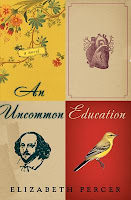
Last week I read two books set in academia, literally back to back. One was The Year of the Gadfly by Jennifer Miller and the other was An Uncommon Education by Elizabeth Percer. I read them both straight through in one day, separated by a period of only 15 minutes.

None of these pairings was a conscious choice on my part.  I thought Middlesex was set in New England until I started listening to it. Oh, wait, I just thought of one pairing and it *was* intentional. Up until this year, I'd never read a book set in North Korea, but then I read Adam Johnson's amazing novel, The Orphan Master's Son.  It was such an utter revelation that when I met Brandon Jones at Winter Institute and learned that his book was also set largely in North Korea, I was conscious of wanting to read it because of the former book.  All Woman and Springtime was a good companion read to the other one, with Johnson's reading more like a hard-hitting journalistic piece and Jones's reading more like the human interest angle.

So what about y'all?  Have you uncovered any patterns in your reading that you weren't conscious of making? 


13 March 2012

Calling All Kindred Spirits: Anne of Green Gables Week

Yet Another Period Drama Blog


Last night when I got home from work, I was a little too wired to settle down with my book, so I did the next best thing: I settled down with my computer to browse book blogs.  That was when I ran across a new-to-me blog called Yet Another Period Drama, who happens to be hosting Anne of Green Gables Week in honor of Anne Shirley's 146th birthday. 

She has a fun little Q&A to answer this week (technically it must have been yesterday's question, but that's okay, I reckon):

1. How many of the Anne books have you read, and how many of the films have you seen? I have read the first book more times than I can count, books 2 and 3 probably more than a dozen times, book 4 maybe half a dozen times, book 5 just twice, and the others not at all.  I lost interest after Anne's House of Dreams. I never watched the last Anne movie which apparently wildly deviates from the books, but I LOVE the other Anne adaptations and watch them regularly.


2. If someone yanked your hair and called you Carrots, what would you do to him? Well, I wouldn't look kindly on the yanked hair bit, but "Carrots" has never seemed like a particularly bad insult to me, so I probably would have laughed and made fun of his lack of imagination.

3. What would you do if Josie Pye dared you to walk the ridgepole of a roof?  Hard to say, because I did have a rivalry like Anne's and Josie's, but I don't think I ever would have done something life-risking to prove myself like that.

4. If you had the opportunity to play any AGG character, which role would you choose?  Well, I think Rachel Lynde would be fun to play, as would Josephine Barry, because each one has a bit of an edge to her.

5. If you were marooned on a desert island, which AGG character would you want to have as a companion? (Can't choose any of the three main characters).  This one is harder.  I might choose Miss Lavender or Mr. Harrison or Matthew.

6. If there were going to be a new film adaptation of the AGG books, and you could have any part in making the movie, what would you choose? Gah, it's not like I have a talent for acting or directing or makeup or lighting, etc.  I guess I'd choose to be a language consultant because I cringe every time I hear a grammatically incorrect piece or anachronistic dialogue.

7. What are, in your opinion, the funniest moments in the AGG books and films? Choose one each.  There are too many to choose easily!  But I love Anne's solemn pronouncements when she's young: her life being a perfect cemetery of buried hopes.  And her desire for a bosom friend. And when she asks Diana for a lock of her jet-black tresses. 

8. What are, in your opinion, the saddest book/movie scenes?  Well. when Matthew dies is an obvious one, but I cry at lots of moments in the movie that aren't necessarily sad, like when Anne gets her puffed sleeves for the first time.

9. Which secondary AGG character would you most like to spend an afternoon with?  I think probably Marilla. 

10. What is your definition of a kindred spirit?  For me, it's a person who loves and is moved by the same things that I am and has similar outlooks on life. In my case, that usually means a shared sense of humor and a love of the same books.

11 March 2012

Book (P)Review: The Innocents by Francesca Segal

Okay, I'm just going to say this up front: the first time I picked up The Innocents, it was for the beautiful cover.  I was completely drawn to it.  Then my sales rep told me that it was a retelling of Edith Wharton's The Age of Innocence, at which point I was totally sold. Ethan Frome notwithstanding, I'm a big fan of Wharton, and though The Age of Innocence isn't my favorite of her books, I knew that this book would go home with me to start reading right away.

Francesca Segal transplants Wharton's story from late 19th century New York City to contemporary London, particularly North West London, and more particularly, the Jewish community thereof. As someone who has lived in very WASPy small towns for most of her life, the world Segal creates was endlessly exotic and fascinating.  If I were a less lazy reader, I would have kept a dictionary (or at least internet access) handy while I read, because it seemed like at least every other page had a word or phrase utterly unfamiliar to me. 

Adam Newman and Rachel Gilbert have been the "it" couple for years, and their entire society takes their eventual marriage as a given. Adam works for Rachel's father, their families have known each other for years, and he is smugly self-satisfied with Rachel's innocent, traditional ways and what that means for their future family. (He's also inordinately proud that he's the only man who's ever settled himself between her loins--eww!) Rachel is the very proper, much-doted-upon older daughter of a wealthy business scion whose family has always been his first priority. Enter Ellie Schneider, Rachel's first cousin, who life has been rocked both by early tragedy and recent scandal, and things start to fall apart. Ellie, a sophisticated and uber-sexy young model, is as unconventional as her cousin is traditional, and eventually Adam's comparisons between the cousins start to tilt in Ellie's favor. But will he act on it, with the eve of his marriage drawing ever nigh?

Anybody who is familiar with The Age of Innocence knows how this book will play out. Segal is remarkable faithful to Wharton's template while creating a world all her own. It's been years since I read the original (at least 15), so I may be misremembering nuances of Wharton's characters, but Segal's protagonists are largely unlikeable.  Adam is, as I said, rather smug and superior throughout most of the book and only near the end realizes he was deluding himself.  Rachel is spoiled and whiny, a girlish woman who actually pouts when she doesn't get her way. Ellie is so simultaneously damaged and defensive of her misguided life choices that it's hard to get a true reading of her.

Olivia, Adam's intellectual sister who resides mostly at Oxford for the duration of the book, is a terrific, if under-used minor character. She also thumbs her nose at her mother's conventions but is still able to see the value of her people's traditions. And then there's Ziva, Ellie and Rachel's grandmother, who is the matriarch of the Gilbert clan and a survivor.  She alone seems to value Ellie's eccentric behavior over Rachel's almost ruthless devotion to the social mores that dictate her lifestyle, her dress, her home.

I enjoyed this book, but I didn't love it, as I simply cannot love a book if I do not also love its characters.  It's a light and easy read and it will be published by Voice in June 2012.  It's a book I suggest for fans of Wharton's book (obviously), readers who enjoy lighter fare tempered with some gravity, and readers who enjoy the British and/or Jewish cultures. Here are some of the passages I liked:

"It is not a contradiction to be a Jew and an atheist--on the God question, Judaism might well be the broadest church of them all....There is a place for you in a synagogue if you don't believe, if you do believe, if you're not sure, of if you only believe during brief moments of turbulence on airplanes or in the final five minutes of a football match in which only divine intervention might save you (27)."

On the upside in living in such a tightly knit community: "There was no life event--marriage, birth, parenthood, or loss--through which one need ever walk alone. Twenty-five other people were always poised to help. The other side of interference was support (103)."

"The older contingent were the fellow members of the Jewish Care Holocaust survivors' group. At their lunches they did not talk about their experiences, Ziva told her family; often nothing was said at all. They spoke of politics, of literature, of their grandchildren. But to be there together was restful, in a place where volunteers ensured there would always be bread on the table. There was a balm in their silences together, just as their listening offered balm to those among them who did decide to talk. Others thought they could imagine, but no one else could know. And here they all were--Ziva's daily lunch companions, men and women shrinking with age but strengthened with pride at their own continued existence. To celebrate ninety when they faced death at nineteen, it was not nothing (215)."

Cheers--this counts as book #11 in my New Authors Challenge, hosted by Literary Escapism!

08 March 2012

Literary Blog Hop: How Do You Do That Reading Thing You Do?

Literary Blog Hop

I'm not positive, but this might be my first Literary Blog Hop of the year.  I miss this one, now that it only happens monthly instead of weekly.  The lovely bloggers at The Blue Bookcase sponsor it and ask of their participants a bookish question (or three) for us all to discuss: How do you find time to read, what's your reading style, and where do you think reading literature should rank in society's priorities?

Firstly, though I am a bookseller, I work long hours and none of those hours can be filled by reading a book.  I hate to burst anybody's romanticized bubble about bookselling, but it's true.  We do not read on the job.  It's still a pretty amazing job, despite that lack of being paid to read. Because I'm a bookseller, though, you might guess that I am a person who makes reading a priority in her life, and you'd be right.  I read every night in bed, some days at lunch, and on my days off I read for a few hours.  I also listen almost exclusively to audio books on my daily commute. If I'm waiting in a restaurant or a movie theatre for the rest of my party to arrive, I'm reading on my phone. Last week I had to serve jury duty and I sat in the selection room with my book, armed with earplugs against the onslaught of the television's blare. I used to watch a lot of television.  Now I just do a lot of reading.

Reading style: not sure how to answer that.  I read pretty widely for my job, but when I read for myself it's mostly literary fiction, some YA, some narrative non-fiction.  Occasionally some chick lit. I'm much less particular when it comes to my audio books than my regular books. I read mostly in my bed, but my husband, god bless him, built a house with an actual library in it and sometimes I read in there.

Society's priorities: now that's a serious question and perhaps hard to answer without sounding elitist. I love Amanda's answer on Dead White Guys and I could just say "ditto" to what she said. But for me, I think everybody should read more. Full stop. There are scientific studies that indicate that people who read (particularly fiction, but any regular reading will do) demonstrate more empathy in real life than people who don't read regularly. And I constantly oscillate back & forth between thinking that it's okay if people read crap as long as they're reading (Twilight, celebrity gossip magazines, etc) and thinking that reading crap doesn't count as *real* reading.

There's a line from the movie Shadowlands, the film about C. S. Lewis, that says "we read to know we're not alone" and I couldn't agree more with that.  Somehow I believe that anybody who says they don't enjoy reading just hasn't found the right book yet. I think reading is just as important and instrumental for knowing others (or "the other") as it is for knowing yourself.  I can't tell you the number of times I've read passages in books and exclaimed, "Yes! Exactly!" There's a euphoria in recognizing yourself in another person's words. And then the euphoria fades, and if you're self-aware enough, the inevitable questions follow: what does that say about me? Why do I feel/act/think that way? Is it a good thing? Or is that something I should work on?

So read more. Observe more. Books help you pay attention to your interior life and keep you aware of what's happening in the outside world. Books can educate or entertain and the best ones do both. Damnit, why doesn't everybody just sit down, shut up, and read?

02 March 2012

Last Month in Review: February 2012

February felt like a slow reading month for me, but the numbers show otherwise.  I got sick near the end of the month, and that boosted the total books I was able to read.  Also, it appears that last month the books I tackled weren't particularly difficult, and only a few were literary, which also contributed to the relatively high number.

1. Alice's Adventures in Wonderland by Lewis Carroll.  This is only the second e-book I've ever read. This was my favorite book as a child and at one point in my life I could recite entire long passages of it. Alas, no more.

2. The Fault in Our Stars by John Green.  Probably my favorite book I read last month.  Review here.

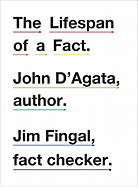
3. The Lifespan of a Fact by John D'Agata and Jim Fingal. One of the more interesting books I've read in ages.  Not a book to be read straight through, despite its slimness.  Review here.

4. Beautiful Ruins by Jess Walter.  Review is forthcoming.

5. The Age of Miracles by Karen Thompson Walker. Review here.

6. Juliet by Anne Fortier.  One of two audio books I managed to "read" this month. Review here.

7. Same Sun Here by Silas House and Neela Vaswani. A middle-grade book.  Review here.

8. All Woman and Springtime by Brandon W. Jones. I probably won't review this one.

9. Home by Toni Morrison.  Not sure why this book was so short, but it felt practically incomplete.  That woman can write, but she didn't write enough of it this time around. Far be it from me to post a bad review of Toni Morrison, which is why you won't see one here.  :)

10. The Lion is In by Delia Ephron.  This book was pure fluff, but it was fun.  Review here.

11. Say Nice Things About Detroit by Scott Lasser. Not sure I'll review this one, either. But Steve Carrell has bought the movie rights and plans to produce/star/direct or whatnot. Which means I kept seeing him as the main character as I was reading, which is too bad.  Not that I don't adore Steve Carrell, but it's just so limiting for the imagination that way.

12. The Red Book by Deborah Copaken Kogan.  Definitely the biggest disappointment this month! Review here.

13. An Uncommon Education by Elizabeth Percer. Review forthcoming.

14. The Year of the Gadfly by Jennifer Miller. Review here.

15. Grave Mercy (His Fair Assassin #1) by Robin LeFevers. This was the first in a planned YA trilogy.  If you love historical fiction and fantasy and a little romance, give it a twirl.  I love the tagline, Why be the sheep when you can be the wolf? But I don't think I will be reviewing it.

16. Another Piece of My Heart by Jane Green. The other audio book.  Review here.

01 March 2012

Book Review: The Lifespan of a Fact by John D'Agata and Jim Fingal

The Lifespan of a Fact is endlessly fascinating! I picked up an ARC of it from NEIBA last fall in an effort to increase my non-fiction reading. Let me try to explain how and why this book got published. Almost 10 years ago, John D’Agata wrote an essay called “About a Mountain” that was rejected for publication from various periodicals due to factual inaccuracies. Enter Believer magazine, who was willing to run the piece with a certain number of inaccuracies, as long as they knew exactly what they were and wouldn’t be surprised by anything post-publication. Believer puts their staff fact checker named Jim Fingal on the case, and over the next seven years the writer and the fact checker go back & forth, dickering about the nature of truth in an essay, where the line is drawn between journalism and narrative non-fiction, and out-and-out lying for the sake of Art. The result is this wonderful little book that prints both the relatively short article as well as much of the fact checking correspondence between John and Jim, which is sometimes aggressive, sometimes funny, and always interesting.

I had no idea until I read this book exactly what happens behind the scenes of any responsibly published nonfiction work. It’s clear to me now, though, that the fact checkers are the unsung heroes of the publishing world, no matter where we draw the line between journalism and creative nonfiction, and after reading this, I’ll never take them for granted again! The book itself has beautiful production values, printed in two colors on each page, with black being used for the original article and the verifiable facts, and a deep maroon for all of the parts that the fact checker challenged.
Sample page from book
NB: Norton published the book last week and it made the front page of the NYT Book Review.

29 February 2012

Book (P)Review: Another Piece of My Heart by Jane Green (audio)

My bookstore received a comp audio of Another Piece of My Heart, so I took a chance on it.  I'd read Jemima J before, but that's about all I knew of Jane Green, other than a vague sense of being chick-lit.  I have different criteria for audio books than for books I read, so I was happy to have this to listen on my commute, despite its not being a title I'd have chosen to read.

The author does her own reading, and at first I found her voice extremely grating.  By the time I came to the end, it didn't bother me nearly as much, but I still wouldn't rate her as a particularly good reader.  It was also mildly disconcerting listening to her American characters speak with her heavily British-inflected voice.

At first I thought the point of view was strictly third person, but then I got to disc #5 and BAM--it switched to first person.  I'm not a fan of multiple narrators or POV switches, and it felt completely random, but eventually the book shifted regularly between third person and first person for most chapters in the second half.  I think this is very lazy writing and it's rarely done well. 

It's the store of a blended family: father, stepmom, two daughters, and an exwife.  Except the older daughter is a nightmare and everybody knows it except her.  The father, Ethan, is so namby-pamby and ineffectual that he might as well be a father from the fairy tales. The stepmother, Andi, isn't wicked at all. She's perfectly sane, if a bit quick to overreact. The exwife is in a drunken state for the first half of the book and hardly worth mentioning. The younger daughter is pliable and reasonable beyond her years.

Lots of family drama: teenage hissy fits, drunken pregnancies, abandoned babies. Emily, the older daughter and the first person narrator in the book, is the most self-absorbed teen I've ever met in fiction OR in real life, and that's saying something.  Listening to her sections was excruciating. If I'd been reading them, the book would have been thrown across the room.

I am part of a blended family myself, though in my case it's the grandchildren who are the ages of the children in this book, and I get that it's hard on both sides.  But this book was so full of angst and drama that it was hard to take seriously, or at least it would have been if I'd been reading it.  Listening to it, though, somehow diminishes its flaws, and I'm not sure why that's the case.

27 February 2012

Book (P)Review: The Year of the Gadfly by Jennifer Miller

As much as I dislike the aches and stuffiness associated with having a cold, I love the fact that I get more reading done when I'm sick than when I'm well. Must have something to do with the hours spent lying horizontal on the bed or library loveseat, and if I take a medicinal sip of bourbon every now and again to heal my sore throat, what of it? (Yes, I drink lots of hot tea with honey & lemon, but I swear that they don't feel like they're doing half the good that a shot of whiskey does.)

Anyway, I digress.  Yesterday I started and finished two novels with similar settings, beginning the first one at about 4:45 am when I was too congested to sleep/breathe lying down, and finishing the second one around 10:30 that night. If I'd known just how similar they were, I probably would've separated my reading of them by more than 15 minutes. By the time I came to the end of the second one, I was having a little trouble separating the details from the two books, but that says more about my frame of mind after reading two books back-to-back at my advanced age than it does about the books themselves.

The Year of the Gadfly by Jennifer Miller captures one of my favorite settings/genres: academia, particularly prep schools. It also happens to be set in western Massachusetts, not far from where I live, so it gets bonus points for that!  Anyway, Iris Dupont is a teenager living in Boston when her best and only friend commits suicide.  A sensitive and curious girl by nature, she deals with the trauma by having conversations with her imaginary friend, the ghost of Edward R. Murrow.  Instead of letting their daughter adjust in her own time, her parents decide to enroll Iris at Mariana Academy, a prestigious prep school two hours west of the city in the Berkshire mountains, so that she can "make a clean break of things."  All this really does is isolate Iris further and drive her to use the mute button for her ongoing conversations with Murrow.

At Mariana, though, not all is as placid as it seems on the surface.  There's corruption in the self-governing student body, the student newspaper is a joke, the headmaster has the local clout to prevent all kinds of incidents from reaching the media, and the members of the mysterious, rabble-rousing secret society called Prisom's Party are the only ones brave enough and dedicated to the truth to do anything about it.

Or are they? There are some voices who whisper that Prisom's Party delivers justice that is heavy on the vigilante, light on the actual justice.

In the meantime, new science teacher Mr. Kaplan is trying to start a revolution on his own by getting his students to think for themselves, question authority, and seek Truth with a capital T, leaving him unpopular with the administration. His extreme, occasionally bullying methods, leave him unpopular with most of the pampered and privileged students as well, since most of them want nothing more than to earn their A for the course and move on to their Ivy League college of choice.

Except Iris, of course, whose determination to uncover the secrets of the Prisom's Party leads her into both the near and distant past of Mariana Academy, and what she finds is troubling. Very troubling indeed. Because more than one student's sanity, or possibly even life, is at stake, and she learns first hand the seduction of power and the shifting shape of truth.

The Year of the Gadfly has the right blend of edginess and day-to-day life to make it an exceedingly quick read.  Fans of the prep school sub-genre, conspiracy theories, Donna Tartt's The Secret History, or Rachel DeWoskin's Big Girl Small will find much to appreciate here.  Its point of view dodges back and forth between past and present, and among two different first-person narratives and two different third-person ones, a style that usually bothers me quite a bit, but Miller carries it off well enough here.  What I liked most about the book, though, is the way it exposes the capacity for brutality that exists within us all. Well, that and a character who is always asking herself, "What would Ed Murrow do?"

Some passages I liked:

"You'd have thought that the Academic League would be more understanding of Iris's quirkiness. They weren't exactly the social creme de la creme. But contrary to popular belief, high school did not run according to a horizontal social hierarchy with the nerds as serfs to the popular despots. The alliances and antagonisms were more complicated than the political dealings of a Third World country. In high school you never knew who was your enemy and who was your friend (154)."

"I felt liberated, free of my previous teenage angst. Though I once believed my superior intelligence would protect me from this Salinger-induced adolescent cliche, it had not. Angst is like the chicken pox -- anyone under the age of twenty-five is susceptible. But as with chicken pox, once you've had your angst, you become more or less immune. How else could high school teachers do their jobs? (187-188)"

This is one of my favorite descriptions of New England mud season. It describes my feelings exactly: "This snow melted into fetid bogs. In those early days of March, you couldn't walk two feet without accruing diarrhetic splatters on the backs of your legs or hearing the sucking, slurping sound of your shoes in the muck (217)."

This book is Miller's first novel and it will pub in May from Houghton Mifflin Harcourt.  I read an ARC from my sales rep, Holly. It also happens to qualify for book #10 in the New Authors Challenge, hosted by Literary Escapism!