22 February 2012

Book Review: Red Book by Deborah Copaken Kogan

Ugh, what a disappointment! First of all, I was expecting non-fiction, but that's my fault for not knowing enough about the book when I picked it up. But more importantly, I was expecting something with a LOT more substance than this book has. I read her first book, Shutterbabe, which was the story of her time as a photojournalist in war-torn countries, and it was just great. Reading The Red Book (a story about four women at their 20th year reunion for Harvard University) makes me feel as if the author has somehow sold out, leaving behind her heavy-hitting stories of worldwide strife for a group of standard and cliched tales of suburban life post-graduation. It teeters dangerously on the brink of being one of those, "oh, it's so hard to be a white person of privilege" books. I didn't quite manage to finish this one 'cause I was pretty sure that I'd just want to throw the book across the room if I did.

Marketing is calling this book "The Big Chill for the Facebook generation." I don't think so. I *will* admit, however, that if my expectations had been adjusted downward, I might have been able to enjoy this book more. Readers who love J. Courtney Sullivan's Commencement or those who simply want a light & easy read or those who attended Harvard themselves and also feverishly read their own respective Red Books when they arrive in the mail will probably find enjoyment in this book. 

NB: I requested a copy of this book from my sales rep because I loved Shutterbabe and it will be published in April by Hyperion.  Too bad it doesn't live up to the author's early potential.  

17 February 2012

Book P(Review): The Lion Is In by Delia Ephron

My sales rep sent me an ARC of The Lion Is In by Delia Ephron, and though I don't think I would have otherwise picked it up on my own, I'm surprised by how enjoyable it is. Two runaway women meet a third runaway woman and together they stumble upon a bar in the middle of nowhere. And oh, yeah--there's a lion, which means things are gonna get interesting.

This book turned out to be light and fun and the perfect palate cleanser after reading a stream of extremely dark (but excellent) novels back to back. This is a story where mostly nothing bad happens and things come out right in the end. You've got to enjoy a book that throws together Marcel the Lion, the hapless driver's ed instructor, a jewel thief, the downtrodden bartender who longs for the love of a good woman, a former Miss North Carolina, and a moronic preacher whose ideals make him the perfect 21st century counterpart to Jane Austen's Mr. Collins. The fact that Marcel becomes  a combination of guru/higher power/shrink for two of the women is pure bonus.

I recommend this book for anybody who is looking for something on the lighter side. I have the strong feeling that the author might turn this chic lit into a chick flick. Think "Thelma & Louise" meets anything by Billie Letts, minus the cliffside-plunge-to-the-death, and you'll have the right idea.

This was not a book that I ruined with dog-ears to mark my favorite passages, but here's one that gives a flavor of the book:

"Rita thinks and it comes back to her what she sensed when she saw him [Marcel the Lion]. She feels it again, something stirring inside her. Barely there, yet for most people it would be unmistakable: a sense of beginning. Rita, however, is so unfamiliar with adventure or possibility that she can't tell the difference between something auspicious and a stomachache (24)."

NB: This book will be published in May by Blue Rider Press, a division of Penguin. It also happens to qualify for my ninth book read for the New Author Challenge, sponsored by Literary Escapism.

14 February 2012

Top Ten Tuesday: Break Another Little Piece of My Heart

I've been absent from this hop all year just about, so I'm happy to jump in with my favorite list of books that broke my heart a little.  If you want to know what the Top Ten Tuesday meme is all about, please stop by The Broke & the Bookish to learn more!


1. The Fault in Our Stars by John Green. This book broke my heart more than a little.  It chewed it up and spat it out and I was the better reader for it. 

Let's face it: everything else is pretty much a distant second, but here are the also-rans:

2. Love Story by Erich Segal.  That's right. It was a schmaltzy book before it was a schmaltzy movie, but I loved it anyway.  Schmaltzy means never having to say you're sorry.

3. If I Stay by Gayle Foreman

4. The Guernsey Literary and Potato Peel Pie Society by Annie Barrows & Mary Ann Shaffer. 

5. Moloka'i by Allan Brennert. Little girl, leper colony,and the brutality of Christian missionaries. Need I say more?

6.One Foot Wrong by Sofie Laguna.  I've never seen such a miserable childhood, nor an ending that so quintessentially defined poetic justice.

7. The Weight of Heaven by Thrity Umrigar.

8. Old Yeller by Frank Gipson. God, my eyes well up just thinking about that book.

9. The Tower, the Zoo, and the Tortoise by Julia Stuart.  What a gem.

10. The Road by Cormac McCarthy

13 February 2012

Book Review: Same Sun Here by Silas House and Neela Vaswani


Upon first hearing of this book, I thought I would love it.  Turns out, I wasn't quite that enamored of it, but it's still a solid 3-star book.  It's a mostly sweet penpal correspondence between River, a boy in small town eastern Kentucky, and Meena, an immigrant Indian girl living in NYC. 

I think this book would work equally well for boys or girls and its quiet lessons in multiculturalism would make this a good book for the classroom. There are also some good moments in environmentalism and activism that don't come across as particularly preachy.  I think the two authors did a pretty good job sounding like the characters in their letters, something fairly difficult to sustain in an epistolary book without the prose coming across as too grown-up.

It's more difficult for me to connect with middle grade novels than with YA ones, and this one just didn't have a spark for me, but I can see this book's becoming a required summer read and gain semi-classic status. One of things I had a minor issue with was River's name.  I grew up in the South, and River (and almost as frequently, Rivers) was always a girl's name, River Phoenix notwithstanding, so it was a bit hard adjusting to that. It would be like reading a book where Jeremy was the female protagonist. But I also heard from my colleague Marika that the two authors wrote the book as a series of letters back and forth to each other, which really appeals to me.

Same Sun Here is published by Candlewick this month and I received a free ARC at Winter Institute that I was lucky enough to get signed.  It also qualifies as entries #7-8 in my New Authors challenge, hosted by Literary Escapism (I think that counts as two since I'd read neither of these authors before).It also qualifies for my South Asia challenge hosted every year by S. Krishna.


11 February 2012

Book P(Review): The Age of Miracles by Karen Thompson Walker

This is the story of how we begin to remember.  Well, no, not really. But that particular Paul Simon lyric has been swirling in my head this morning and I was just itching to use it.  This is actually the story of the day the earth stood still slowed down. And the days after that, and the days after that. Nobody knows why the earth's rotation has slowed, but Julia is eleven the day this discovery is announced on the news, with varying degrees of panic.

At first the effect is subtle, resulting in a few extra minutes each day, but before long there is a worldwide dilemma on how to handle the growing length of days--and there is much debate whether to follow the 24-hour clock time of old, or to establish "real time" that coincides with each new solar day.  "Clock timers" declare dominion over the "real timers" and marginalize them in society in much the same way all minority groups have been marginalized through the ages.

The first indication that the world might be headed for end times is the birds.  The new gravity from the slowed rotation has crippled their ability to fly and navigate.  Next, the magnetic field changes and weather becomes unpredictable.  Crops wither under 24 straight hours of sun followed by an equal period of darkness. Newly erected greenhouses powered by sunlamps deplete the energy grids.  Clearly it's only a matter of time before all food sources will disappear.

In the meantime, Julia is just trying to make sense of what is happening in her personal life amidst these larger world turmoils. Her best friend's family moves away to join a desert Mormon collective in Utah. Her unrequited crush finally approaches her. Her mother succombs to gravitational sickness.  Her father may or may not be having an affair with a "real timer." In other words, a typical adolescence. 

In other, other words, this is a coming-of-age, pre-apocalyptic novel.

I think I just coined the word "pre-apocalyptic."  If I didn't, please don't disabuse me of the notion just yet.

The book is, overall...pretty good.  I liked it.  I didn't rock my world; there were no profound insights into the human experience; and at no point was the prose so spectacular that I wanted to read something a second time in order to savor it. It's simply a quick and easy read with a moderately interesting premise, but I'm a little perplexed about the pre-publicity buzz surrounding this book.  The manuscript created a bidding war in the publishing world and word on the street is that the author walked away with a cool million from her US publisher and another $500k each from her Canadian and UK ones.  Since this is a debut novel and not a particularly brilliant one I that, I just have to wonder if the publishing world's head is up its collective arse. You can't read a major newspaper these days without coming across an article touting the demise of the book world as we know it.  And it's moves likes this, which are questionable at best and asinine at worse, that makes me doubt both publishing's business acumen and sense of value.

Which of course means that this book will probably be a raging bestseller and a major motion picture and I am just the lone voice in the wilderness who isn't in on the joke questions it all.

I received a bound manuscript of this book from my lovely sales rep Michael Kindness.  It will be published this summer by Random House, and it happens to qualify for entry #6 for the New Authors Challenge, hosted by Literary Escapism. 

10 February 2012

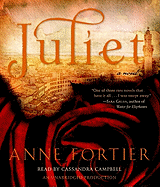
Audio Book Review: Juliet by Anne Fortier

I actually borrowed this audio book from my mother, for whom I had bought it about a year ago when I saw it on the bargain table at my bookstore.  When I was visiting her over the Christmas hols I noticed that she hadn't listened to it yet, so I helped myself to it. Much as I love David Sedaris and Bill Bryson, I was growing a mite weary of re-listening to their audios on my daily commute, week in and week out.

The story turned out to be surprisingly satisfying, not least because Cassandra Campbell is a very good reader for this story.  I did think that it was a touch over-long, and if I had been reading the physical book I definitely would have skimmed over a good bit of it, but despite that, I give it a solid recommendation.

There are two storylines that eventually come together; one is a modern day young woman named Julie Jacobs, an American who travels to Siena to track down a mysterious inheritance that her mother may have died trying to protect, and the other is the story of Giulietta Tolomei, whose doomed love for Romeo Mariscotti haunted 14th-century Siena and was the inspiration for Shakespeare's famous play. I far more enjoyed the earlier storyline, with its intrigues and betrayals, than the modern one, where Julie seems a little whiny and ineffective. 

Medieval curses, hidden statues, lying scoundrels, mystical rites, horse races, precious heirlooms, family feuds, the Mafia, and yes, two pairs of star-cross'd lovers, all have their roles to play, and while most readers (or listeners) won't have much trouble guessing the various plot twists, there's no denying that this is a frolicsome book.

Now, of course, I have to plan a trip to Siena to visit all of the fabulous places described in such loving detail and I've got an unanswerable hankering to delve into more books with an Italian setting.  It's been years since my one and only visit to that country and this book makes me yearn to return.

This book serves as entry #5 in the New Authors Challenge, hosted by Literary Escapism.

08 February 2012

Book P(Review): Billy Lynn's Long Halftime Walk by Ben Fountain


Summary from my ARC: Told over the course of a single day*--specifically Thanksgiving Day at Texas Stadium, as the Dallas Cowboys take the field--Billy Lynn's Long Halftime Walk is the story of Bravo Squad, eight survivors of a ferocious firefight with Iraqi insurgents, whose bravery and and valor have made them national heroes. In the final hours of their Pentagon-sponsored "Victory Tour," Bravo's Silver Star-winning hero, nineteen-year-old Billy Lynn, will confront hard truths about love and death, family and friendship, war and politics, duty and honor.

I'd say that the first 3/4 of so of this book held me spellbound, but once I made it past that point, it bogged down a bit for me.  Maybe because the book feels as if it reads in real time.  Although there is one significant flashback section, the bulk of the book takes place during the course of one football game (* the summary says one day, but the book opens when the limo delivers them to the stadium for the game and it closes when the same limo picks them up to take them to Fort Hood, so it's really an afternoon).

That being said, I feel that in addition to being a fresh and edgy book, this may be an important book. So far it's the only one I've read coming out of the Iraq War that subsumes itself in neither action sequences nor in an overwrought family or romantic drama. This one seems to be just as much about the concept of war itself as the politics behind it and how America feels about it. (Though given the book takes place mostly in Texas, especially Dallas, we're not really given a look at the dissenters' side of things.) 

Billy Lynn is a fascinating character, a boy thrust into the army (in lieu of doing hard time) after taking a crowbar to his sister's ex-fiance's car for gallant but misguided reasons. He's a thoughtful young man, fully aware that the labels of "hero" mean nothing when one's actions are guided neither by bravery nor fear, but simply reactionary to any given situation, including Bravo's famous firefight with the Iraqi insurgents: one day you're the hero and the next day you're cowering under your humvee and refusing to come out. His thoughts are never far away from his imminent return to Iraq, nor from his buddy, Shroom, who died the day Billy was labeled a hero.

Ben Fountain's novel is the first book coming out of the Iraq War (that I've read, at least) that seems willing to say that war is, more than anything else, a commercial enterprise. It's difficult not to draw these parallels about the US's involvement in Iraq with, say, the Dallas Cowboys franchise and the oil-steeped politics of the state in which the book is largely set, or the larger-than-life characters we meet, such as the Dallas Cowboys' owner or the man who spends the book negotiating a movie deal for Bravo. War as commercially motivated enterprise, not a political one, isn't a new concept per se, but it goes a long way in increasing this particular reader's distaste for it, because if it's really not about oil, really not about protecting our interests, and really not about freeing a people from their dictator's rule, then it's really not something I can ever understand, or wish to, for that matter.

Karl Marlantes blurbs this book, and he's not a writer whose opinion I take lightly, especially when it comes to the topic of war. He calls it "the Catch-22 of the Iraq war," and with a comment like that, I'm not sure that there's anything more to add.  I'll just conclude with some passages that resonated with me as I read it:

"So they lost Shroom and Lake, only two a numbers man might say, but given that each Bravo has missed death by a margin of inches, the casualty rate could just as easily be 100 percent. The freaking randomness is what wears on you, the difference between life, death, and the horrible injury sometimes as slight as stooping to tie your bootlace on the way to chow, choosing the third shitter in line instead of the fourth, turning your head to the left instead of the right. Random. How that shit does work on your mind (26-27)."

"Those people [movie studios, producers, etc], the kind of bubble they live in? It's a major tragedy in their lives if their Asian manicurist takes the day off. For those people to be passing judgment on the validity of your experience is just wrong, it goes beyond wrong, it's ethics porn. They aren't capable of fathoming what you guys did (57)."

I love this moment between Billy and his sister Kathryn, re: their father:
" 'He's an asshole,' Kathryn said. 
To which Billy: 'You just now figured that out?' 
'Shut up. What I mean is he likes being an asshole, he enjoys it. Some people you get the feeling that can't help it? But he works at it. He's what you'd call a proactive asshole' (75)."

Billy with his nephew on leave:
"Based on his highly limited experience with small children, Billy had always regarded the pre-K set as creatures on the level of not-very-interesting pets, thus he was unprepared for the phenomenal variety of his little nephew's play. Whatever came to hand, the kid devised some form of interaction with it. Flowers, pet and sniff. Dirt, dig. Cyclone fence, rattle and climb. Squirrels, harass with feebly launched sticks. 'Why?' he kept asking in his sweetly belling voice, as pure as marbles swirled around a crystal pail. Why? Why? Why? And Bill answeing every question to the best of his ability, as if anything less would disrespect the deep and maybe even divine force that drove his little nephew toward universal knowledge...So is this what they mean by the sanctity of life? A soft groan escaped Billy when he thought about that, the war revealed in this fresh and grusome light. Oh. Ugh. Divine spark, image of God, suffer the little children and all that--there's real power when words attach to actual things. Made him want to sit right down and weep, as powerful as that. He got it, yes he did, and when he came home for good he'd have to meditate on this, but for now it was best to compartmentalize, as they said, or even better not to mentalize at all (82-83)."

The reader never gets the full picture of exactly what happens to earn the Bravo Squad their Victory Tour back home, but here is one of Billy's ruminations on it: "All your soldier life you dream of such a moment and every Joe with a weapon got a piece of it, a perfect storm of massing fire and how those beebs blew apart, hair, teeth, eyes, hands, tender melon heads, exploding soup-stews of shattered chests, sights not to be believed and never forgotten and your mind simply will not leave it alone. Oh my people. Mercy was not a selection, period. Only later did the concept of mercy even occur to Billy, and then only in the context of its absence in that place, a foreclosing of options that reached so far back in history that quite possibly mercy had not been an option there since before all those on the battlefield were born (125)."

Read this book.  Seriously, just read it.

NB: This book will be published by Ecco in May 2012 and I received an ARE from my fabulous sales rep, Anne DeCourcey. This book also qualifies as book # 4 for the New Author Challenge, hosted by Literary Escapism (it's not for debut authors, but for new-to-you authors).

06 February 2012

Laughter Through Tears is my Favorite Emotion, or Book Review: The Fault in Our Stars by John Green

I met John Green a couple of weeks ago when he was participating on a panel for Winter Institute and was one of the big draws at the author receptions.  Up until then, I had only read Will Grayson, Will Grayson, a book that he cowrote with David Levithan, and while I knew he was a beloved author, I really had no clear idea why until that time in New Orleans.  On his panel he kept talking about his horrifically tragic books, but he himself was so damn funny (and WG, WG tipped decidedly toward the funny end of the scale, not the tragic one) that it was difficult for me to feature.

I left work on Thursday with a signed copy of The Fault in Our Stars tucked under my arm, winging a comment back to my colleague Marika as I left that I was looking forward to the emotional ride. Little did I know! I was barely into Chapter One before the bed was shaking with laughter and my husband sniffed at me from over the top of his own, decidedly-less-funny book,  The Crossing by Cormac McCarthy. My cats didn't seem to mind, though my sweet Murray did start licking my face when the laughter abruptly shifted to tears. I'm telling you, this book chewed up my heart and spit it back out again, but I had an absolutely Grand Time for the duration.

You know the movie Steel Magnolias?  I love that movie, not least for its eminent quotability, and one of the first lines I committed to memory was one of Dolly Parton's: "Laughter through tears is my favorite emotion." Well, this book is the pure-dee embodiment of that sentiment.  There were times my shoulders were a-shakin' and I'd be very hard-pressed to determine if it were more from the tears or more from the laughter, for I could suppress neither for very long.

Probably most of you who are reading this review know exactly what this book is about, but for my mom and my husband, and those of you who don't, perhaps, have your fingers on the pulse of YA publishing, here's a short summary: two teenagers meet and fall in love.  So far, so good.  But it's where they meet that shapes this book's content--at a support group for teens with cancer. The reader absolutely knows from the beginning that the book cannot end well, but that doesn't keep the reader from hanging herself with the hope rope. (Or maybe that's just me.) Augustus and Hazel wouldn't be your typical teens even without their missing or weakened body parts.  They're smart, curious, snarky, and introspective. Their cancer has taken them beyond politeness to that realm where fools are not suffered gladly and where the concept of pussyfooting around topics other (read: normal) people find uncomfortable is unfathomable.

The dialogue is exactly what dialogue should be in real life, if only we got to rehearse and make it perfect yet authentic. The pathos in the book is a fitting tribute to the title's source: nothing less venerably tragic than Shakespeare's Julius Caesar ("The fault, dear Brutus, is not in our stars,/ But in ourselves").

There's book talk, video games, a friend who goes blind, some mild vandalism, a trip to Amsterdam, Two Very Important Venn diagrams, and an asshole of an author, and throughout it all the book boils down to narrative perfection. My two main critiques of the book have nothing to do with the content and everything to do with design: 1) the cover design is not very good, and in fact it's hard to read the text underneath the white cloud, and (2) The lovely-to-look-at typeface which is also, in fact, easy to read, is never identified.

This book was published by Penguin/Dutton in January 2012 and I purchased my own copy of it. If it had been published by Random House, it would have contained a note on the type and would have identified the book designer, etc. Shame on you, Dutton!

03 February 2012

Book (P)Review: The Storytelling Animal: How Stories Make Us Human

Jonathan Gottschall has written an extremely interesting and captivating book in The Storytelling Animal: How Stories Make Us Human.  I was surprised upon picking up this book how little that is not story in our lives: there are the expected books of course, but also tv, movies, jokes, commercials, lies, gathering 'round the water cooler, advertisements, songs, conspiracy theories and even sports events; really, the list goes on.  Gottschall delves into the fascinating evolutionary, cultural, biological, and even neurological reasons why our species is defined by our storytelling, both communal and individual. 

Did you know, for example, that according to one study "heavy fiction readers had better social skills--as measured by tests of social and empathic ability--than those who mainly read nonfiction"? (I'm curious to know if readers overall have the same relative abilities compared to non-readers...)

This is by far the most compelling non-narrative nonfiction I've read in simply ages, and what's more, it should be required reading for every single reader and writer out there. 

NB: This book will be published by Houghton Mifflin Harcourt in April 2012 and I received a copy at Winter Institute. It also happens to qualify for my third book of the year for the New Authors Reading Challenge for 2012, hosted by Literary Escapism.

01 February 2012

Last Month in Review: January 2012

Well, I started a helluva lot more books in January than I ended up finishing, that's for sure! According to Goodreads at one point during the month I had 9 books going simultaneously, but overall it's not too poor a showing, despite the lack of reviews:

1. Gold by Chris Cleave.  Really, really liked this book, and the writing is several notches above Little Bee, in my opinion. This one's coming out in July.

2. The Great Gatsby by F. Scott Fitzgerald.  Unbelievably, I'd never read this classic before. I liked it better than I expected to.  Thanks, Mom, for keeping at me and giving me your own copy to read!

3. Pride and Prejudice by Jane Austen.  Yes, I'd read this book many times before this, but this was my first eBook to read on my iPhone, and I started it it about a year prior to completing it.

4. Masque of the Red Death by Bethany Griffin.  This YA book was a lot of fun to read.

5. New Orleans Day by Day by Frommer's.  This might seem like it's cheating, but I really do think I read the book cover to cover prior to my trip to Winter Institute because I wanted to revel both in my own memories of New Orleans and in the planning of any free time I might have.

6. The Flame Alphabet by Ben Marcus.  Okay, admittedly I didn't quite finish this one, but I put in some hard time on it and I read most of it, so I'm counting it. Mostly I just kept reading 'cause I thought it would get better, but I was bored to tears despite the excellent writing and the intriguing premise.  I have no idea how this book turned out bad, but it did.

7. Norwegian Wood by Haruki Murakami.  I read this for Reading Rambo's readalong, and I don't think I was the only participant left feel underwhelmed by the experience.  (I have a few musings on it; if you do a search for "Norwegian Wood" you should find them all if you wish to read them.)

8. The Storytelling Animal: How Stories Make Us Human by Jonathan Gottschall.  The only non-fiction I was able to finish this month.  It was good and mini-review coming soon.

9. The Light Between Oceans by M. L. Stedman. Really excellent storytelling.  The writing was occasionally uneven but more often than not, I was truly moved by the pathos in the story.

10. Billy Lynn's Long Halftime Walk by Ben Fountain. Review forthcoming.